Showing posts with label summer. Show all posts

Thursday, July 18, 2013

The Island That Time Forgot


The breeze played on the water and the salt spray washed the faces of the small crew as we headed out into the Miles River. Captain Rich Scofield guided Volunteer out into the water as we began to discuss what we might find on the blob of green that awaited our arrival in the middle of the River. Mike Hardesty, Assistant Director of the Chesapeake Semester and Ben Ford, Special Projects Coordinator, began talking in earnest about what their students might learn from a trip over to Long Point Island. Ecology, history, land-use, and Tom Horton’s book “Bay Country” were all mentioned as they discussed the potential lesson plans that could be developed around this ancient island.
600529_10151531073346262_575847619_n.jpg
Entrance to Long Point Island.
We puttsed up to a small dock on the far shore and Rob Forloney from the Chesapeake Bay Maritime Museum hopped ashore to tie up. As he did, a man started slowly walking toward the dock. “Hi. You must be the group from Washington College” he said as he approached the boat. He introduced himself as Jimmy Rouse, the owner of Long Point Island. As we all hopped back in the boat and started out for the Island, Jimmy began to tell stories of growing up on that Island. “We spent summers out here. There were three huge black walnut trees that we sold for lumber…we used the money from those trees to build the bulkheads…My father and his brothers build the cabins themselves.” Jimmy told us that he remembers when the island was connected to the mainland. In fact his family supervised driving bulldozers across the narrow land bridge onto the island for agricultural purposes.
Finally we bumped up against the dock and hopped onto shore. In front of us was a beautiful wooden cabin nestled under a canopy of mature oaks and pines. I could just imagine Thoreau walking out of the front door and sauntering off through the trees. “We can have this fixed up,” Jimmy’s wife said as we walked through the front door of the cabin. Mike immediately started pacing around happy as a kid in a candy shop, or as an environmentalist in a cabin in the woods. I could hear snippets of excited mutterings concerning team building and campfires. As my eyes drifted from the windows to the trees I couldn’t help but wondering about the incredible stories a place like this would hold. Cutoff from the mainland for over a hundred years, farmed until the 1920’s and then logged in the 1970’s, some of these trees had seen it all. The entire history of western civilization locked away in the rings of the white oak that swayed silently in the summer breeze. They had seen farmers tear up the soil to put in irrigation ditches. They had seen loggers tear down huge black walnut trees leaving gaping wounds in the canopy. They had seen children racing through the woods, combing the beaches for arrowheads, and studying the birds as they hopped through the undergrowth. Now they were watching a new group move through. A group that would fill the air with campfire smoke, good whole-body laughs, and exclamations of wonder and discovery.
1069921_10151531073776262_1465923606_n.jpg
The CES crew explores the forest on Long Point Island.
“Would you like to walk the length of the island?” Jimmy asked. Between the cabin and the far beach we discussed the history of the land at length. We were immersed in a discussion about the evolution of agriculture in the Chesapeake Bay region when we were interrupted by a Velociraptor. Well, at least it sounded like a Velociraptor, but after a little bit of searching we discovered that there was a heron rookery on the island.  For the next few minutes we watched as adult herons went to and from the nest bringing food for their young. In the distance we could hear the plaintive chirping of Osprey and Eagles. Beneath our feet the spent bodies of horseshoe crabs reminded us of the passing of the seasons, and brought us back to the task at hand. It might’ve been then, maybe it was while we were looking for raspberry bushes in one of the tangles of underbrush, or it might’ve been when we were all sitting on the porch of one of the cabins talking about the challenges and changes of the Chesapeake. Regardless of when it happened, we didn’t notice it until we were all loaded back on the boat and we began thinking about getting home that Rob said, “I think my watch stopped!”
None of us could figure out why that might’ve happened at the time, but I think now that I know the answer. I don’t think anything went wrong; I think that the Chesapeake, for just a brief moment, managed to break through all of our planning and give us an invitation. The Chesapeake called us with herons, the circling Osprey, the bodies of horseshoe crabs, and the slow march of box turtles.  For those of us who were there and for the students who will arrive there in a few short weeks with the Chesapeake Semester, Long Point Island will always be a place to stand still. A place to let the Chesapeake lap the soles of your feet and the quiet oaks shelter you, beckoning your return to peace, quiet, and good earth. 
946580_10151531073701262_1960298862_n.jpg
Ben's box turtle.
This article was written by Rachel Field, Program and Intern Coordinator for the Center for Environment & Society.

Tuesday, September 25, 2012

Waterfront Festival 2012!

Check out this video of the Waterfront festival! Filmed by Brian Palmer and Eric Broussard of Washington College. Students, staff, faculty, and community members turned out on Saturday for a beautiful day of fun on the Chester River. This year featured:
Free boat rides on the Callinectes
Sailing and kayaking on the Chester River
Model Boat Building
Pony Rides
Scales & Tails
the "Fishmobile"
and many more wonderful activities for the whole family!
Of course, the highlight of the day was the Cardboard Boat Regatta. We had many brave competitors this year, but sleek design and excellent construction brought Captain Brian Palmer of "Chessie Racing" the Cape Horn award for first around the course. Our own "Chesapeake Semester" boat Captained by Mike Hardesty, made it around the course for second place. "No Place like Home" followed closely behind for third place. The coveted People's Choice Award also went to "No Place like Home." There was no surprise that the Cutty Sark Award for best design went to "Chessie Racing," and it was also no surprise that "No Place like Home" won Best Theme & Costumes! For their innovative method of swimming their boat around the course and their exceptional team spirit, "Chariots of Fire" took home the Linda Greenlaw Award. The final award of the day went to "Dance to your own Tune" who, in a heart-wrenching display of teamwork, dragged their boat around the course after it sank on the starting line. All of our competitors were wonderful, and we look forward to seeing YOU on the water next year at the 2013 Waterfront Festival and Cardboard Boat Race!

Friday, August 24, 2012

A Week of Warblers!

This past week at the banding station was filled with exciting warblers! Here are some pictures of the best and the brightest. Also check out our weekly banding totals for a more detailed look at what we've been catching at Foreman's Branch Bird Observatory.
This past week we got a high number of American Redstarts of all ages and sexes gathered in one area of the study site. Perhaps they are traveling in a group?
We banded 5 Black and White Warblers this week.
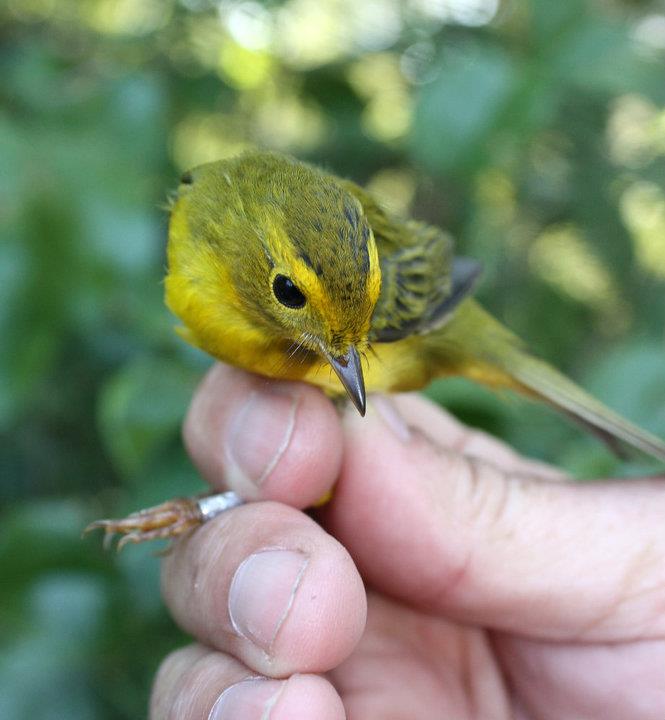
We also got an HY (hatch year) Female Wilson's Warbler this week. You can see that the top of her head is much greener than a male's would be.
This HY Male Blackburnian Warbler was a real treat. We usually only get one a year, and some years we don't get any.
Ok, so this is not a warbler but we broke the record for number of Belted Kingfishers captured this year, and that's pretty neat too!
All signs point to...Migration! Hopefully we'll continue to get interesting and exciting birds in the coming weeks. Be sure to check out day-by-day updates on our facebook page and our weekly banding totals on our Website.

Monday, August 20, 2012

Summer Soundtrack


Maybe your summer soundtrack is “Call Me Maybe” by Carly Rae Jepsen or maybe you’re hearing waves rolling in on a beach.  I’ve got an earful of cicadas!  Cicadas are the pulsating and buzzy sounding insects you hear from trees and bushes in mid to late summer.  Only the males call, they vibrate a special organ on their abdomen called a tymbal.  The Eastern Shore of Maryland actually has about half a dozen species of annual cicada which should not be confused with the periodical cicada which emerges every 17 years in huge numbers (like in 2004). 

Swamp Cicada from Baltimore County.  Photo by Jim Brighton   http://picasaweb.google.com/109627728893182537813 
Annual cicadas have a pretty cool life cycle:  females lay eggs in soft twigs and other plant material.  Tiny nymphs hatch out the same summer and drop to the ground where they burrow into the soil.  Over the next few years (the exact length of time depends on the species) the nymphs feed on roots and grow bigger and bigger.  Finally, one summer when they are about an inch or so long, they dig their way out of the ground, climb up to a safe perch and hatch out of their brown skin.  They sit a while to allow their wings to unfold and strengthen then they fly away leaving their crunchy shell behind.   The adults only live a few weeks before reproducing and dying.

The crunchy brown shell that remains on a tree trunk after a cicada has emerged.
In addition to being super cute in a bug sort of way, I also like cicadas since they pose no threat to humans, they do not bite or sting.  Under normal circumstances they do not damage crops or plant material.  Humans in many parts of the world actually eat cicadas as a good protein source.

Cicadas, by the way, are NOT locusts.  Locusts are grasshoppers, in the scientific order Orthoptera.  Cicadas are more closely related to aphids and are in the order Homoptera.   You may recall from high school biology the classification runs kingdom, phylum, class, order, family, genus, species so organisms in different orders are really really unrelated!

Cicada from CRFRS grasslands.

There are loads of other critters adding music to your summer days and nights.  Crickets and katydids are other insects that make noise and don't forget about the various frogs and toads.  Why not take a few minutes on a summer evening this week to stop and listen to all the creatures singing!


Maren Gimpel is a field ecologist at the Chester River Field Research Station.  Photos and stories about the goings on of CRFRS can be found at www.facebook.com/crfrc or at www.washcoll.edu/ces/chesterriverfieldresearchcenter