Showing posts with label photos. Show all posts

Thursday, July 18, 2013

The Island That Time Forgot


The breeze played on the water and the salt spray washed the faces of the small crew as we headed out into the Miles River. Captain Rich Scofield guided Volunteer out into the water as we began to discuss what we might find on the blob of green that awaited our arrival in the middle of the River. Mike Hardesty, Assistant Director of the Chesapeake Semester and Ben Ford, Special Projects Coordinator, began talking in earnest about what their students might learn from a trip over to Long Point Island. Ecology, history, land-use, and Tom Horton’s book “Bay Country” were all mentioned as they discussed the potential lesson plans that could be developed around this ancient island.
600529_10151531073346262_575847619_n.jpg
Entrance to Long Point Island.
We puttsed up to a small dock on the far shore and Rob Forloney from the Chesapeake Bay Maritime Museum hopped ashore to tie up. As he did, a man started slowly walking toward the dock. “Hi. You must be the group from Washington College” he said as he approached the boat. He introduced himself as Jimmy Rouse, the owner of Long Point Island. As we all hopped back in the boat and started out for the Island, Jimmy began to tell stories of growing up on that Island. “We spent summers out here. There were three huge black walnut trees that we sold for lumber…we used the money from those trees to build the bulkheads…My father and his brothers build the cabins themselves.” Jimmy told us that he remembers when the island was connected to the mainland. In fact his family supervised driving bulldozers across the narrow land bridge onto the island for agricultural purposes.
Finally we bumped up against the dock and hopped onto shore. In front of us was a beautiful wooden cabin nestled under a canopy of mature oaks and pines. I could just imagine Thoreau walking out of the front door and sauntering off through the trees. “We can have this fixed up,” Jimmy’s wife said as we walked through the front door of the cabin. Mike immediately started pacing around happy as a kid in a candy shop, or as an environmentalist in a cabin in the woods. I could hear snippets of excited mutterings concerning team building and campfires. As my eyes drifted from the windows to the trees I couldn’t help but wondering about the incredible stories a place like this would hold. Cutoff from the mainland for over a hundred years, farmed until the 1920’s and then logged in the 1970’s, some of these trees had seen it all. The entire history of western civilization locked away in the rings of the white oak that swayed silently in the summer breeze. They had seen farmers tear up the soil to put in irrigation ditches. They had seen loggers tear down huge black walnut trees leaving gaping wounds in the canopy. They had seen children racing through the woods, combing the beaches for arrowheads, and studying the birds as they hopped through the undergrowth. Now they were watching a new group move through. A group that would fill the air with campfire smoke, good whole-body laughs, and exclamations of wonder and discovery.
1069921_10151531073776262_1465923606_n.jpg
The CES crew explores the forest on Long Point Island.
“Would you like to walk the length of the island?” Jimmy asked. Between the cabin and the far beach we discussed the history of the land at length. We were immersed in a discussion about the evolution of agriculture in the Chesapeake Bay region when we were interrupted by a Velociraptor. Well, at least it sounded like a Velociraptor, but after a little bit of searching we discovered that there was a heron rookery on the island.  For the next few minutes we watched as adult herons went to and from the nest bringing food for their young. In the distance we could hear the plaintive chirping of Osprey and Eagles. Beneath our feet the spent bodies of horseshoe crabs reminded us of the passing of the seasons, and brought us back to the task at hand. It might’ve been then, maybe it was while we were looking for raspberry bushes in one of the tangles of underbrush, or it might’ve been when we were all sitting on the porch of one of the cabins talking about the challenges and changes of the Chesapeake. Regardless of when it happened, we didn’t notice it until we were all loaded back on the boat and we began thinking about getting home that Rob said, “I think my watch stopped!”
None of us could figure out why that might’ve happened at the time, but I think now that I know the answer. I don’t think anything went wrong; I think that the Chesapeake, for just a brief moment, managed to break through all of our planning and give us an invitation. The Chesapeake called us with herons, the circling Osprey, the bodies of horseshoe crabs, and the slow march of box turtles.  For those of us who were there and for the students who will arrive there in a few short weeks with the Chesapeake Semester, Long Point Island will always be a place to stand still. A place to let the Chesapeake lap the soles of your feet and the quiet oaks shelter you, beckoning your return to peace, quiet, and good earth. 
946580_10151531073701262_1960298862_n.jpg
Ben's box turtle.
This article was written by Rachel Field, Program and Intern Coordinator for the Center for Environment & Society.

Friday, July 12, 2013

Pilgrim on Radcliffe Creek

Arial view of Radcliffe Creek
Despite the time that I have spent in Chestertown as a student of Washington College, it was not until about two months ago that I first heard of Radcliffe Creek. Even as an Environmental Studies major, this creek was something that I had not been introduced to in my two years in school. As I began to research the history of the creek and its watershed, I met with some members from the town who are currently planning the construction of three retention pools at the source of Radcliffe Creek. Radcliffe Creek begins to form very near to the LaMotte building and the Acme shopping center on Route 213. The mouth of the creek is roughly a quarter mile from the Boat House on South Cross Street and feeds directly into the Chester River. Radcliffe Creek was identified as an area of impaired water in the Middle Chester River Restoration Action Strategy (MD DNR 2002) and the purpose of these retention pools is to help improve the water and habitat quality of Radcliffe so that it may no longer be considered impaired. During my research it was discovered that there used to be an old dumpsite in an area just south of Cromwell Clark Road. Additionally, there was a coal/gas manufacturing plant located on 813 West High Street—an area that backs up directly to Radcliffe Creek—that operated from 1910 to 1946. After these discoveries, the idea of performing sediment sampling and trace metal testing in addition to nutrient and water quality testing became much more prevalent. The creek itself is primarily fed by ground water and storm water runoff and has very low salinity (the average salinity of the creek is a mere 0.2 ppt). The plant life within the creek consists mostly of phragmites but there are healthy strands of cattails amongst the phragmites in addition to some forest vegetation along some of the banks of the creek.
Osprey with dinner

The times that I have kayaked along the creek I have seen numerous Ospreys, Red-winged Black Birds, Great Blue Herons, two muskrats, a few turtles (I was not able to get close enough to determine the type of turtle), and some very small fish. The creek itself has high potential to become a fantastic area for wildlife, as it is already home to many different types of organisms. Since there had been no prior delineation of it, one of the first things that I began doing when I found out about Radcliffe Creek was delineate its watershed in order to get an idea of the land that contributes to its runoff. I also went out on the creek and measured various depths of Radcliffe so that a 3D bathymetric model of the creek can be produced at some point. Since there has been virtually no research conducted on Radcliffe Creek, there is a lot to catch up on and even more to pursue. My primary focus for the past two months has been to test the overall water quality of Radcliffe. I perform biweekly surveys of the creek and measure temperature, salinity, dissolved oxygen (both in mg/L and % saturation), Chlorophyll a and pH using a water quality sonde. I also take water samples from four different sites along the creek and use them to test for ammonia, nitrate, orthophosphate, total nitrogen and total phosphorus. The average amount of total nitrogen within the creek has been 2.5 mg/L and the average total phosphorus is 0.26 mg/L which produces a nitrogen (N) to phosphorus (P) ratio of about 10 to 1 rather than the16 to 1 that is typically needed for phytoplankton. (This means that for every atom of P used a phytoplankton cell needs 16 atoms of N – on average). It appears that N may be limiting phytoplankton growth, at least for the short period of time that I have been investigating the Radcliffe Creek water quality.
Students paddling on Radcliff Creek
My hope is that this research and data collection will be able to continue over the years so that a better understanding of the ecosystem quality of Radcliffe Creek emerges. Radcliffe has huge potential to become an even more wonderful and habitable creek than it is currently and my hope is that by raising awareness and learning more about the charming creek, Radcliffe will become one of the gems of Chestertown. I would like to thank all of the people who have helped me with this research—my fellow students Sarah Winters, Olivia Hughes and Rachel Stoddard and professors Christian Krahforst, Leslie Sherman and Karl Kehm. I would not have been able to do this without their fantastic efforts.

Drew Hobbs is an Environmental Studies major with minors in Computer Science and Chemistry. He will be starting his Junior year at Washington College in the fall.

Wednesday, January 23, 2013

Good Ol' River Mud

"Tributaries Matter: Investigating the Biogeochemical Cycling of Reactive Constituents
in Sub-estuaries of the Chesapeake Bay"
I'll be honest. I wasn't sure exactly what I was in for with a lecture titled, "Tributaries Matter: Investigating Biogeochemical Cycling of Reactive Constituents in Sub-estuaries of the Chesapeake Bay." I was pretty confident I knew what a tributary was...and an estuary, but all that stuff in the middle? Not a clue. Yesterday we were fortunate to host Commander Joseph Smith from the US Naval Academy who was going to answer all my questions. We settled in to Litrenta, sat back, and learned some astonishing things about watersheds and sediment movement.

CDR Smith began his discussion with the Hudson River. All the way back to his time as a graduate student he has been studying the movement of sediment in estuaries. What he has learned has astonished his advisers and the wider scientific community. Instead of being like a pipe that dumps water into the oceans, estuaries experience constant movement of sediment toward the ocean and back toward the land. One example in particular encapsulated the importance of this multi-directional movement. In 2006 the Navy attempted to relocate the legendary World War II aircraft carrier USS Intrepid, but after a half hour of effort from a small fleet of tugboats, it became apparent that the ship was stuck in the mud! CDR Smith explained that this was a result of sediment being deposited in the harbor from upriver and from the ocean. The amount of sediment that settled around the ship worked out to be about 20 inches a year. This event, which confirmed CDR Smith's theory of high sedimentation rates, astonished the scientific community.

USS Intrepid with tugboats
Taking what he has learned about the tendency for estuaries to pick up materials, CDR Smith has focused his studies on nearby Blue Plains Advanced Waste water Treatment Plant to determine what sort of impact the waste water is having on the Chesapeake Bay. Specifically CDR Smith has been looking at a specific element Iodine 131. He was quick to point out that the levels at which he studied I131 were well below the levels that would cause any harm to surrounding populations. CDR Smith has been tracing I131 because it has comparable qualities (radioactive half-life) to other more harmful substances. This means that CDR Smith can more accurately model what would happen if one of the more harmful materials (heavy metals, pesticides, certain nutrients etc.) were to be released into the Bay's Watershed.

Among the many insights that Smith has gained through his work is the fact that environmental factors have a huge impact on the movement of these potentially harmful materials. Wind speed, wind direction, temperature, and pH are just a few of the factors that can influence the spread of these materials. In order to form a more complete model CDR Smith and CES Associate Director Doug Levin are working together to monitor every aspect of the Chester and the Severn. Among the many pieces of technology being used in this ambitious project are buoys that constantly collect data, and autonomous kayaks that will be able to independently patrol the rivers. This project, when completed, will make these two rivers the best known rivers in the Chesapeake Bay Watershed and potentially the entire United States.
Chesapeake Bay
Article written by Rachel Field, Program and Intern Coordinator for Washington College's Center for Environment & Society. 


Tuesday, October 23, 2012

Science and Art: Understanding our Relationship with the Environment

     This past week the Center for Environment and Society proudly sponsored two lectures. The first was given by John Beardsley of Dumbarton Oaks and titled, “Art in the Environment: Sketches from the Field.” On the following night, the very day of it’s inception 40 years ago, Tom Horton discussed the Clean Water Act with a lecture titled, “40 Years of the Clean Water Act Through the Lens of the Chesapeake Bay.” The succession of these two lectures beautifully reflects the mission of the Center for Environment and Society. First, Beardlsey discussed the tension expressed by 19th century nature artists who represented the conflict between viewing the landscape with an artists’ eye as opposed to a developers. Beardsley went on to describe the 20th century movement he describes as the second era of nature art. Now we see a movement toward manipulating the environment to make powerful statements about beauty, purpose, and our relationship with the natural world.
Lightning Field, New Mexico by Walter DeMaria
     Beardsley ended his talk with a discussion of the benefits of a union between artistic and ecological pursuits. It is common practice to use art as a meditative or therapeutic exercise. Beardsley suggested that this practice could be applied to the broader relationship between all human beings and the natural world. In many ways Horton echoed this message the following evening with his call for a broader approach to conservation.
     Horton summarized many of the successes and the setbacks that have been a part of the history of the Clean Water Act. With population levels rising in the Chesapeake Bay region the amount of nutrient runoff and waste is increasing at enormous levels despite our best efforts. Horton mentioned the change from a wild oyster harvest to a system in which oysters are farmed as an example of one way that life in the Chesapeake Bay has changed. By encouraging interdisciplinary approaches, thorough scientific analysis, and community-based efforts, Horton believes that we will be able to keep improving the state of the Bay.
     Both Beardsley and Horton reminded their audiences that only by working together from many different perspectives do we have a chance of making real progress and saving the land that sustains us.
Foreman's Branch of the Chester River

Tuesday, September 25, 2012

Waterfront Festival 2012!

Check out this video of the Waterfront festival! Filmed by Brian Palmer and Eric Broussard of Washington College. Students, staff, faculty, and community members turned out on Saturday for a beautiful day of fun on the Chester River. This year featured:
Free boat rides on the Callinectes
Sailing and kayaking on the Chester River
Model Boat Building
Pony Rides
Scales & Tails
the "Fishmobile"
and many more wonderful activities for the whole family!
Of course, the highlight of the day was the Cardboard Boat Regatta. We had many brave competitors this year, but sleek design and excellent construction brought Captain Brian Palmer of "Chessie Racing" the Cape Horn award for first around the course. Our own "Chesapeake Semester" boat Captained by Mike Hardesty, made it around the course for second place. "No Place like Home" followed closely behind for third place. The coveted People's Choice Award also went to "No Place like Home." There was no surprise that the Cutty Sark Award for best design went to "Chessie Racing," and it was also no surprise that "No Place like Home" won Best Theme & Costumes! For their innovative method of swimming their boat around the course and their exceptional team spirit, "Chariots of Fire" took home the Linda Greenlaw Award. The final award of the day went to "Dance to your own Tune" who, in a heart-wrenching display of teamwork, dragged their boat around the course after it sank on the starting line. All of our competitors were wonderful, and we look forward to seeing YOU on the water next year at the 2013 Waterfront Festival and Cardboard Boat Race!

Friday, August 24, 2012

A Week of Warblers!

This past week at the banding station was filled with exciting warblers! Here are some pictures of the best and the brightest. Also check out our weekly banding totals for a more detailed look at what we've been catching at Foreman's Branch Bird Observatory.
This past week we got a high number of American Redstarts of all ages and sexes gathered in one area of the study site. Perhaps they are traveling in a group?
We banded 5 Black and White Warblers this week.
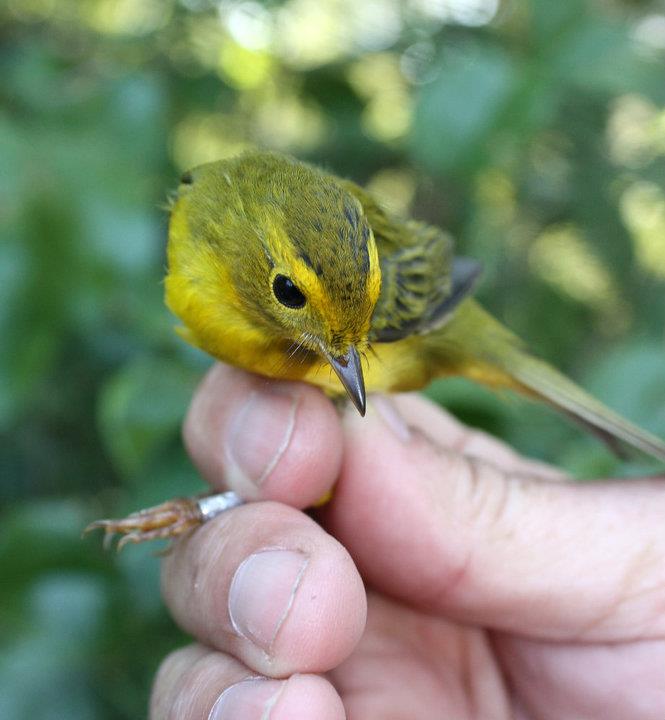
We also got an HY (hatch year) Female Wilson's Warbler this week. You can see that the top of her head is much greener than a male's would be.
This HY Male Blackburnian Warbler was a real treat. We usually only get one a year, and some years we don't get any.
Ok, so this is not a warbler but we broke the record for number of Belted Kingfishers captured this year, and that's pretty neat too!
All signs point to...Migration! Hopefully we'll continue to get interesting and exciting birds in the coming weeks. Be sure to check out day-by-day updates on our facebook page and our weekly banding totals on our Website.

Tuesday, August 14, 2012

Searching for Rangia

Our summer began with periodic excursions up and down the mighty Chester River looking for “soft” sediment that we hope to use for characterizing the chemistry of the bottom of Chester River. Why, you might ask? Well, many of the “chemicals of environmental concern”(COEC) are hydrophobic -which literally means afraid of water- but more appropriately reflects the sticky-particle bound nature of many of these contaminants. They don’t like to be dissolved in water, but like to bind to the surfaces of particles and, ultimately, the sediment. Our interest in COECs is directed towards a better understanding of how these chemicals are introduced into the aquatic environment, how they affect resident organisms, and where they may ultimately end up. Anyway, this communiqué is not about COECs but is more about the benthos – the critters that we found in or on the sediment during our summer of mucking about in boats. Overall, we found very little living in the sediments we collected - or more appropriately, very little macro (large, non-microscopic) organisms. For those macro benthic organisms we did find we noted where, when, and what we found; either an occasional oyster, some mussels, and most often – when there was anything – the mighty Rangia.
 This is blog is about the brackish clam,Rangia cuneata (Fig.1); what their role may be in the Chester River ecosystem and whether they might be a good indicator of contaminant exposure and bio-accumulation (accumulation of chemicals in the tissues of the organism) in the Chester.
Fig. 1. Rangia collected from the Chester River about 2 miles south of Chestertown
The Rangia clam, according to information provided by the Maryland Department of the Environment (MDE)1, is a brackish (low salinity) clam that is often found in waters with salinities between 5-15 parts per thousand (fresh water is 0 ppt, ocean water at the mouth of the Chesapeake is ~32 ppt). They often live in highly turbid waters (water that contains a lot of suspended particles, muddy), often preferring soft substrates; usually a sand/mud mixture with vegetation detritus. They are subtidal suspensivores (they filter material out of the water column for food) and are also considered saprophytic, that is they also derive nourishment from dead or decaying organic matter (much like bacteria or fungi). The species found in the Chesapeake are Rangia cuneata and, to this date, the Chesapeake is the northern most reach of their distribution. Apparently, they weren’t always a part of the Chesapeake ecosystem. In fact (according to MDE), the first known sighting of R. cuneata was in 1960 in the Potomac River and are now found in the brackish tributaries and creeks of the upper Chesapeake Bay. Does the timing of their occurrence correspond to increases turbidity in the Chesapeake? Definitely an interesting question…. As a food source for humans, they are considered non-desirable, often because they have an earthy, muddy taste. Investigators from NOAA2 report a very active fishery for Rangia along the east coast of Mexico where they are used as a supplement to local shellfish and fish cuisine, often because they present a less desirable pallet when served alone. In Figure 2, we show where we have found Rangia this summer. The sites where we collected sediment are indicated by black triangles and where we found Rangia clams are shown by the red circles. One hope is that these organisms can help filter and clean the highly turbid waters of the Chester or the even the lower salinity realms of the Bay . Some investigators3 show that Rangia is a good indicator of a system under significant stress; that they represent a situation where other organisms struggle to survive and the ecosystem is in poor health. Rangia are also being investigated as a potential contaminant cleaner-upper for the impact of the BP oil release in the Gulf of Mexico4 Figure 2. Surface sediment grabs sites (black triangles) from the Chester River, summer 2012. The red dots overlay stations where we found Rangia clams.
Fig. 2.
Surface sediment grabs sites (black triangles) from the Chester River, summer 2012. The red dots overlay stations where we found Rangia clams
One of our interests at the Center for the Environment and Society is whether Rangia can serve as biological indicator for contaminant exposure in the Chester River ecosystem. Do contaminants like lead, copper, arsenic and other COEC accumulate in Chester River resident organisms? Is Rangia a potential pathway for the transfer COEC to “higher” organisms that reside in the Chester River ecosystem (e.g., white perch, osprey, humans,etc) where COEC may become further concentrated as they move up the food chain? We don’t know, but we will be measuring the content of some of the COEC in their soft tissues using the relatively new high tech inductively-coupled Mass Spectrometer at Washington College. Stay tuned!


Samuel Hartman, a summer Hodson Fellow, looks to find the optimal site for our next sediment grab
 Christian Krahforst is the Mellon Post Doctoral Fellow of Biogeochemistry for the Center for Environment & Society at Washington College.

1.  http://www.mde.state.md.us/programs/Marylander/CitizensInfoCenterHome/Documents/www.mde.state.md.us/assets/document/Rangia.pdf
2.  http://spo.nmfs.noaa.gov/mfr663/mfr6632.pdf
4.  http://www.nola.com/news/gulf-oil-spill/index.ssf/2011/03/lowly_rangia_clam_as_oil-sucki.html

Thursday, July 26, 2012

Chino Farm: A Week in Pictures

This week at the banding station Amanda Spears caught one of the first migrants of the season: a Black and White Warbler!
Bobolinks are officially here to stay. Well...at least to molt. The grasslands are getting filled up with Bobolinks as they feast on foxtail grass and begin their molt before continuing south on migration.
This past week banding on the grasslands jumped in numbers. Among the birds being captured were Orchard Orioles, like this one.
The nesting continues! Grasshopper Sparrows are trying to get one more clutch in before they have to start worrying about migration.
We've been happy to see plenty of young Northern Bobwhite around the grasslands this summer. It seems like they've had a productive breeding season. To check out the latest from the grasslands take a look at our Facebook page.
Next week marks the start of fall banding at FBBO, don't forget to check out our website for the latest updates from the banding station!

Thursday, July 12, 2012

Summer Scenery at Chino Farm

Even in the heat, it's a lot of fun being outside all day surrounded by animals and plants. Here are some highlights from the Chester River Field Research Station this past week!
Blue Grosbeak Nest

Breeding Ovenbirds at FBBO

Interns and Guests around the  banding truck
Field Ecologist Dan Small extracts a bird during banding
The long-awaited return of the Bobolinks has finally arrived! 
Don't forget to check out the latest from CRFRS and FBBO on the website and facebook pages!

Monday, July 9, 2012

Monardas of Maryland


Each time I walk by some Monarda in the restored grasslands at Chino Farms I’m reminded how beautiful nature can be.  Others working in the fields this summer have also commented on the beauty of these plants and asked if I knew what they were. Inspired by these questions, here is an overview of the species of Monarda found in Maryland.


Bee Balm, Monarda didyma. Has brilliant crimson flowers with oval, narrowly pointed and toothed leaves. Found in moist woods, thickets and bottomlands.

Monarda is a genus made up of 16 species, five of which occur in Maryland and all of which are endemic to North America. Monardas belong in the family Lamiaceae (the mint family) and share several characteristics common in the mint family such as having square stems and leaves that are fragrant when crushed.
Four out of the five species occurring in Maryland can be found on Chino Farms. Dotted Monarda and Wild Bergamot are found growing in the restored grasslands while Bee Balm and Purple Bergamot were planted in the native plant garden at Foreman’s Branch Bird Observatory. 


Purple Bergamot, Monarda media. Purple Flowers with leaves that are oval or broadly triangular. Found in moist woods and thickets.
Wild Bergamot, Monarda fitulosa. Pink flowers with narrowly triangular or oval leaves that are pointed and toothed. Upland woods, thickets and prairies.

Several Native American tribes used plants in the genus Monarda for medicinal purposes. They were used as antiseptics, made into a tea to treat mouth and throat infections and also used to stop headaches.  Monards were also used to season game meat. 


Dotted Monarda, Monarda punctata. Whitish to pink flowers with narrow oval or oblong leaves. Found in dry fields and roadsides.

Bee Balm, White Bergamot and Purple Bergamot are found in the mountainous regions of Maryland, while Wild Bergamot and Dotted Monarda are widespread and can be found throughout the state. White Bergamot is ranked as a S1 plant (highly state rare) by the Maryland Natural Heritage Program, and Purple Bergamot is ranked as a SU meaning possibly rare but status uncertain. 


White Bergamot, Monarda clinopodia.  White flowers with narrow triangular or oval leaves that are rounded at the base. Found in moist woods, thickets, ravines and banks. Photo by Homer Price.


 Thanks to Homer Edward Price for his use of his photo, http://www.flickr.com/photos/28340342@N08/2981721109/. Information for this post was gathered from Wikipedia, the MD Natural Heritage Programs, Rare, Threatened and Endangered Plants of MD report, http://dnr.maryland.gov/wildlife/Plants_Wildlife/rte/pdfs/rte_Plant_List.pdf. An excellent wildflower guide, Wildflowers in the Field and Forest by Steven Clemants and Carol Gracie was also very useful.

Dan Small is a field ecologist at the Chester River Field Research Station

Thursday, April 26, 2012

Recycled Art Sculpture Contest- Winners!

The Center for Environment & Society is pleased to announce the winners of the Recycled Art / Sculpture Contest:
1st place - "Juliper" (Coca Cola guitar) - Julia Erbe
2nd place - "Shelldon" (green turtle) - Chelsea Vetick
3rd place - "Colosseum" (stadium) Spencer Van Cise, Austin Yocum, Benjamin Longwell
Overall Most Green/OMG - "Leaning Tower of Platinum" - Casey Frische
Incoming SGA president Zach Pandl, professor Ricky Sears and professor Mark Wiest served on the Judges Panel. They awarded cash prizes ($25, $20, $15 for first through third place, respectively) during the campus Earth Day celebration on Friday, April 20th. The OMG winner garnered herbs from Redman Farms.
Student artworks were also on display during the Earth Day Festival & Mutt Strut in Downtown Chestertown on Saturday, April 21st. Chelsea Vetick staffed the CES booth and set up the recycled artworks next to Jacqueline Melvin's "Love is a Library" display. Sarah Giordano and Kathy Thornton created a College composting exhibit. SEA advisor Tara Holste promoted local foods and agriculture at her table.

Thursday, April 19, 2012

Society for Applied Anthropology Annual Conference

Society for Applied Anthropology Annual Conference

Graduates of the 2011 Chesapeake Semester successfully presented at the 72nd Annual Conference of the Society for Applied Anthropology in Baltimore on "Bays, Boundaries, and Borders." In attendance were Ashley Burdette, Zach Hall, Joseph Hemphill, Brendyn Meisinger, Zoe Newell, Kelly Kunsch, Rettie Duke, and Jeffery Sullivan.

Each of the eight presentations was inspired by group final projects completed last fall. At the start of the fall's Chesapeake Semester, students were divided into two groups addressing separate "umbrella" topics. Working within their respective groups they developed focus and individual research tracks supporting their assigned group topic. The first group developed research around the connection between "waterscapes and landscapes." The second group tackled "Edges," exploring the notion that the edge is the farthest point from the center.

Monday, December 19, 2011

Chesapeake Semester: Peru slideshow

At the final presentations of the Fall 2011 Chesapeake Semester, Director of Digital Media Services Brian Palmer presented a slideshow of photos and video he took during the semester.

This is a rough slideshow that was shown during the final presentations of the 2011 Chesapeake Semester at Washington College. It is a glimpse into roughly 21 hours and 5300 photos taken in Peru during the 4th journey of the Chesapeake Semester. Please be on the look out for the full documentary which will premiere on campus at Washington College in late January or early February 2012.


You can also view photos of the presentations here.

Friday, November 4, 2011

New Chesapeake Semester photos!

View all the pictures here: Chesapeake Semester 2011

Ashley Burdette '14 takes a stroll along the beach looking for megaladon shark's teeth.
Rettie Duke '13 uses an iPad to look a little closer behind the scenes at the Calvert Marine Museum.
Rettie Duke '13 uses an iPad to look a little closer at the Calvert Marine Museum.
Dr. Bill Schindler shows students which mushrooms in the forest are edible.
CRA partners with Ducks Unlimited on a wetland project which enhances habitat for waterfowl, provides farmers with income for marginal lands, and increases water filtration.

Tuesday, May 3, 2011

Clean up at Eastern Neck Island

Eastern Neck National Wildlife Reguge Shoreline Cleanup

The Center for Environment & Society partnered with the Friends of Eastern Neck to conduct a shoreline cleanup on April 30, 2011. Members of the community banded together to remove trash from the marshy edges of Eastern Neck Island, creating a better environment for wildlife and improving the appearance of the shoreline. View pictures of the event here.

Thursday, March 31, 2011

Locavore Lit Fest is Huge Success


The first ever Locavore Lit Fest took place in Chestertown March 25 and 26. There was a great turnout, and festival goers were able to hear from and interact with authors who spoke on food related subjects from the environmental impacts of agriculture to the native wild foods of the Eastern Shore, with a dose of humor and the simple joys of eating thrown in for good measure! The WC Dining Hall had local food specials at lunch on Friday to kick off the weekend, and several local authors, including CES' own Program Manager, Tara Holste '07, and Assistant Director of Admissions Aundra Weissert '08, spoke on their inspiration to begin writing about local foods.

Click here for the press release and schedule of the event, and here to view more pictures!


Wednesday, November 17, 2010

Full Moon Kayaking

October 22, 2010


Six Washington College students (Dan Danko, Nicole Robinson, and 4 other member of SEA) were among 22 paddlers on a Full Moon Float at Eastern Neck Island on October 22nd. It was brisk but calm as the group launched from Bogles Wharf and headed for the Duck Inn Trail. "It was peaceful gliding through the water and watching the moon come up," said Katherine Thornton, a sophomore at Washington College who took some of these photos. The event was organized by the Center for Environment & Society, and John Wagner, head of the College's waterfront programs, provided kayaks, paddles and life vests for students. The other intrepid paddlers (including a father and son in an Old Town canoe) brought their own gear and flashlights. The next group kayaking event at ENNWR is planned for 21 June 2011 in celebration of the summer solstice.

Eastern Neck Island has approximately 15 miles of shoreline, but the fall Shoreline Cleanup concentrated on a section of garbage and debris that washed ashore during recent storms. About a dozen people, including many volunteers from the Student Environmental Alliance (Nicole, Kathy, etc), hauled 11 bags of trash from the beach up to an abandoned trail head. The litter weighed approximately 200 pounds (not including an old tire)! Kevin Hemstock took a great photo of the cleanup participants - all women - that ran in the October 28th edition of the Kent County News.

Do bats make you think of Halloween and vampires? Beyond the myth and folklore, bats are one of the most important groups of animals. U.S. Fish & Wildlife specialist Colby Hawkinson taught a class on bat ecology, called Curious Creatures of the Night, on October 31st. Nine participants learned what bats eat, where they live and how they behave. Afterwards they built bat boxes using Boy Scouts' kits provided by Washington College's Center for Environment & Society.

All the October events at Eastern Neck National Wildlife Refuge were part of a recent advertising campaign coordinated by CES and the Friends of Eastern Neck. The ongoing goal is to raise awareness of the Wildlife Refuge and the many recreational opportunities on the island. "Hiking trails, waterfowl counts, birdwatching, kayaking, beachcombing and fishing - it's all in your backyard," says Fairchild. If you have program suggestions, or for more information, please contact jfairchild2@washcoll.edu or (410) 778-7295. "We hope to see you at the Wildlife Open House on the island on December 4th," says Ms. Fairchild.