Showing posts with label Caretakers of Creation. Show all posts

Monday, October 29, 2012

Sandy Visits Downrigging Weekend

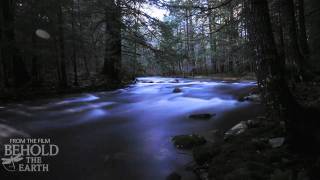
Photo courtesy of "Behold the Earth"
This past weekend some of us were priveledged to hear David Conover and Tim Eriksen present at the Prince Theater. Conover spoke of the intersection between society and nature that he explores in his forthcoming documentary "Behold the Earth." In this film Conover uses breathtaking scenery, haunting folk melodies, and poignant interviews to explore America's divorce from nature. While sitting in my house this morning watching the trees groan in the winds of Hurricane Sandy, I couldn't help but hear the soulful notes of Eriksen's song "Every Sound Below" and consider the power of this storm.
Rain lashing, candles sputtering, birds calling, the street cleaner slowly driving by. These were the sounds reaching through my "cocoon." Conover described Americans as a people who travel between a series of cocoons, forgetting to spend time outside of our meticulously managed environments. Today, Sandy is forcing the people on the east coast out of their cocoons.
Satellite image of Hurricane Sandy

Since agriculture became the modus operandi for humankind we have slowly moved to create more distance between ourselves and our surroundings. This process was much enhanced by the dawn of the technological era. Humans now have so much power over their environment that some suggest we have entered an "anthropocene," or geological period defined by human action disrupting the surface of the Earth. Socially this technology has moved children away from the outdoors and in front of screens. Conover noted that in the last decade children have spent an average of over 7 hours a day in front of a screen.
Photo courtesy of "Behold the Earth"

Conover does not seek to provide a particular answer to this problem, rather he is making an attempt to understand why our divorce from nature started and exactly what that divorce looks like. The fierce embrace of Hurricane Sandy brings this question right into our homes, through leaky windows, flooded basements, and loss of power: electrical and otherwise.

Tuesday, October 23, 2012

Science and Art: Understanding our Relationship with the Environment

     This past week the Center for Environment and Society proudly sponsored two lectures. The first was given by John Beardsley of Dumbarton Oaks and titled, “Art in the Environment: Sketches from the Field.” On the following night, the very day of it’s inception 40 years ago, Tom Horton discussed the Clean Water Act with a lecture titled, “40 Years of the Clean Water Act Through the Lens of the Chesapeake Bay.” The succession of these two lectures beautifully reflects the mission of the Center for Environment and Society. First, Beardlsey discussed the tension expressed by 19th century nature artists who represented the conflict between viewing the landscape with an artists’ eye as opposed to a developers. Beardsley went on to describe the 20th century movement he describes as the second era of nature art. Now we see a movement toward manipulating the environment to make powerful statements about beauty, purpose, and our relationship with the natural world.
Lightning Field, New Mexico by Walter DeMaria
     Beardsley ended his talk with a discussion of the benefits of a union between artistic and ecological pursuits. It is common practice to use art as a meditative or therapeutic exercise. Beardsley suggested that this practice could be applied to the broader relationship between all human beings and the natural world. In many ways Horton echoed this message the following evening with his call for a broader approach to conservation.
     Horton summarized many of the successes and the setbacks that have been a part of the history of the Clean Water Act. With population levels rising in the Chesapeake Bay region the amount of nutrient runoff and waste is increasing at enormous levels despite our best efforts. Horton mentioned the change from a wild oyster harvest to a system in which oysters are farmed as an example of one way that life in the Chesapeake Bay has changed. By encouraging interdisciplinary approaches, thorough scientific analysis, and community-based efforts, Horton believes that we will be able to keep improving the state of the Bay.
     Both Beardsley and Horton reminded their audiences that only by working together from many different perspectives do we have a chance of making real progress and saving the land that sustains us.
Foreman's Branch of the Chester River

Thursday, September 24, 2009

Caretakers of Creation

Tuesday, October 13, 2009
Rabbi Nina Beth Cardin will lecture on "Caretakers of Creation: Jewish Perspectives" on Tuesday, October 13, at 10:30 a.m. at Emmanuel Church located at 101 N. Cross Street in Chestertown. The lecture is free and open to the public. Immediately following the program, discussion will continue over lunch in the Parish Hall. Lunch is $15 and reservations are required by October 7th by contacting jfairchild2@washcoll.edu or 410-778-7295.
Ordained in 1988 from the Jewish Theological Seminary, Rabbi Cardin now serves as Director of the Baltimore Jewish Environmental Network (BJEN) at the Pearlstone Conference and Retreat Center. She is also an environmental activist and educator, an author, and a freelance sustainability consultant. In 1978 Rabbi Cardin co-founded the Jewish Women's Resource Center, which is now part of the National Council of Jewish Women—NY Section; and in the mid-1990s she co-founded the National Center for Jewish Healing and the New York Jewish Healing Center. She most recently served as General Consultant to COEJL, the Coalition on the Environment and Jewish Life (2007-2009).
This program is presented by the Center for Environment & Society at Washington College, the Chestertown Havurah, and the Chester Valley Ministers Association as the kickoff event of the "Caretakers of Creation" lecture series. Father Allen LaMontagne, the Reverend of St. Paul's Parish, Kent, says the public forums will feature different faith perspectives in the context of the community's relationship with the land. "Discussion will center on our role as people of faith in the care of creation," he says.