Showing posts with label Chester River. Show all posts

Friday, July 12, 2013

Pilgrim on Radcliffe Creek

Arial view of Radcliffe Creek
Despite the time that I have spent in Chestertown as a student of Washington College, it was not until about two months ago that I first heard of Radcliffe Creek. Even as an Environmental Studies major, this creek was something that I had not been introduced to in my two years in school. As I began to research the history of the creek and its watershed, I met with some members from the town who are currently planning the construction of three retention pools at the source of Radcliffe Creek. Radcliffe Creek begins to form very near to the LaMotte building and the Acme shopping center on Route 213. The mouth of the creek is roughly a quarter mile from the Boat House on South Cross Street and feeds directly into the Chester River. Radcliffe Creek was identified as an area of impaired water in the Middle Chester River Restoration Action Strategy (MD DNR 2002) and the purpose of these retention pools is to help improve the water and habitat quality of Radcliffe so that it may no longer be considered impaired. During my research it was discovered that there used to be an old dumpsite in an area just south of Cromwell Clark Road. Additionally, there was a coal/gas manufacturing plant located on 813 West High Street—an area that backs up directly to Radcliffe Creek—that operated from 1910 to 1946. After these discoveries, the idea of performing sediment sampling and trace metal testing in addition to nutrient and water quality testing became much more prevalent. The creek itself is primarily fed by ground water and storm water runoff and has very low salinity (the average salinity of the creek is a mere 0.2 ppt). The plant life within the creek consists mostly of phragmites but there are healthy strands of cattails amongst the phragmites in addition to some forest vegetation along some of the banks of the creek.
Osprey with dinner

The times that I have kayaked along the creek I have seen numerous Ospreys, Red-winged Black Birds, Great Blue Herons, two muskrats, a few turtles (I was not able to get close enough to determine the type of turtle), and some very small fish. The creek itself has high potential to become a fantastic area for wildlife, as it is already home to many different types of organisms. Since there had been no prior delineation of it, one of the first things that I began doing when I found out about Radcliffe Creek was delineate its watershed in order to get an idea of the land that contributes to its runoff. I also went out on the creek and measured various depths of Radcliffe so that a 3D bathymetric model of the creek can be produced at some point. Since there has been virtually no research conducted on Radcliffe Creek, there is a lot to catch up on and even more to pursue. My primary focus for the past two months has been to test the overall water quality of Radcliffe. I perform biweekly surveys of the creek and measure temperature, salinity, dissolved oxygen (both in mg/L and % saturation), Chlorophyll a and pH using a water quality sonde. I also take water samples from four different sites along the creek and use them to test for ammonia, nitrate, orthophosphate, total nitrogen and total phosphorus. The average amount of total nitrogen within the creek has been 2.5 mg/L and the average total phosphorus is 0.26 mg/L which produces a nitrogen (N) to phosphorus (P) ratio of about 10 to 1 rather than the16 to 1 that is typically needed for phytoplankton. (This means that for every atom of P used a phytoplankton cell needs 16 atoms of N – on average). It appears that N may be limiting phytoplankton growth, at least for the short period of time that I have been investigating the Radcliffe Creek water quality.
Students paddling on Radcliff Creek
My hope is that this research and data collection will be able to continue over the years so that a better understanding of the ecosystem quality of Radcliffe Creek emerges. Radcliffe has huge potential to become an even more wonderful and habitable creek than it is currently and my hope is that by raising awareness and learning more about the charming creek, Radcliffe will become one of the gems of Chestertown. I would like to thank all of the people who have helped me with this research—my fellow students Sarah Winters, Olivia Hughes and Rachel Stoddard and professors Christian Krahforst, Leslie Sherman and Karl Kehm. I would not have been able to do this without their fantastic efforts.

Drew Hobbs is an Environmental Studies major with minors in Computer Science and Chemistry. He will be starting his Junior year at Washington College in the fall.

Wednesday, January 23, 2013

Good Ol' River Mud

"Tributaries Matter: Investigating the Biogeochemical Cycling of Reactive Constituents
in Sub-estuaries of the Chesapeake Bay"
I'll be honest. I wasn't sure exactly what I was in for with a lecture titled, "Tributaries Matter: Investigating Biogeochemical Cycling of Reactive Constituents in Sub-estuaries of the Chesapeake Bay." I was pretty confident I knew what a tributary was...and an estuary, but all that stuff in the middle? Not a clue. Yesterday we were fortunate to host Commander Joseph Smith from the US Naval Academy who was going to answer all my questions. We settled in to Litrenta, sat back, and learned some astonishing things about watersheds and sediment movement.

CDR Smith began his discussion with the Hudson River. All the way back to his time as a graduate student he has been studying the movement of sediment in estuaries. What he has learned has astonished his advisers and the wider scientific community. Instead of being like a pipe that dumps water into the oceans, estuaries experience constant movement of sediment toward the ocean and back toward the land. One example in particular encapsulated the importance of this multi-directional movement. In 2006 the Navy attempted to relocate the legendary World War II aircraft carrier USS Intrepid, but after a half hour of effort from a small fleet of tugboats, it became apparent that the ship was stuck in the mud! CDR Smith explained that this was a result of sediment being deposited in the harbor from upriver and from the ocean. The amount of sediment that settled around the ship worked out to be about 20 inches a year. This event, which confirmed CDR Smith's theory of high sedimentation rates, astonished the scientific community.

USS Intrepid with tugboats
Taking what he has learned about the tendency for estuaries to pick up materials, CDR Smith has focused his studies on nearby Blue Plains Advanced Waste water Treatment Plant to determine what sort of impact the waste water is having on the Chesapeake Bay. Specifically CDR Smith has been looking at a specific element Iodine 131. He was quick to point out that the levels at which he studied I131 were well below the levels that would cause any harm to surrounding populations. CDR Smith has been tracing I131 because it has comparable qualities (radioactive half-life) to other more harmful substances. This means that CDR Smith can more accurately model what would happen if one of the more harmful materials (heavy metals, pesticides, certain nutrients etc.) were to be released into the Bay's Watershed.

Among the many insights that Smith has gained through his work is the fact that environmental factors have a huge impact on the movement of these potentially harmful materials. Wind speed, wind direction, temperature, and pH are just a few of the factors that can influence the spread of these materials. In order to form a more complete model CDR Smith and CES Associate Director Doug Levin are working together to monitor every aspect of the Chester and the Severn. Among the many pieces of technology being used in this ambitious project are buoys that constantly collect data, and autonomous kayaks that will be able to independently patrol the rivers. This project, when completed, will make these two rivers the best known rivers in the Chesapeake Bay Watershed and potentially the entire United States.
Chesapeake Bay
Article written by Rachel Field, Program and Intern Coordinator for Washington College's Center for Environment & Society. 


Monday, October 29, 2012

Sandy Visits Downrigging Weekend

Photo courtesy of "Behold the Earth"
This past weekend some of us were priveledged to hear David Conover and Tim Eriksen present at the Prince Theater. Conover spoke of the intersection between society and nature that he explores in his forthcoming documentary "Behold the Earth." In this film Conover uses breathtaking scenery, haunting folk melodies, and poignant interviews to explore America's divorce from nature. While sitting in my house this morning watching the trees groan in the winds of Hurricane Sandy, I couldn't help but hear the soulful notes of Eriksen's song "Every Sound Below" and consider the power of this storm.
Rain lashing, candles sputtering, birds calling, the street cleaner slowly driving by. These were the sounds reaching through my "cocoon." Conover described Americans as a people who travel between a series of cocoons, forgetting to spend time outside of our meticulously managed environments. Today, Sandy is forcing the people on the east coast out of their cocoons.
Satellite image of Hurricane Sandy

Since agriculture became the modus operandi for humankind we have slowly moved to create more distance between ourselves and our surroundings. This process was much enhanced by the dawn of the technological era. Humans now have so much power over their environment that some suggest we have entered an "anthropocene," or geological period defined by human action disrupting the surface of the Earth. Socially this technology has moved children away from the outdoors and in front of screens. Conover noted that in the last decade children have spent an average of over 7 hours a day in front of a screen.
Photo courtesy of "Behold the Earth"

Conover does not seek to provide a particular answer to this problem, rather he is making an attempt to understand why our divorce from nature started and exactly what that divorce looks like. The fierce embrace of Hurricane Sandy brings this question right into our homes, through leaky windows, flooded basements, and loss of power: electrical and otherwise.

Tuesday, October 23, 2012

Science and Art: Understanding our Relationship with the Environment

     This past week the Center for Environment and Society proudly sponsored two lectures. The first was given by John Beardsley of Dumbarton Oaks and titled, “Art in the Environment: Sketches from the Field.” On the following night, the very day of it’s inception 40 years ago, Tom Horton discussed the Clean Water Act with a lecture titled, “40 Years of the Clean Water Act Through the Lens of the Chesapeake Bay.” The succession of these two lectures beautifully reflects the mission of the Center for Environment and Society. First, Beardlsey discussed the tension expressed by 19th century nature artists who represented the conflict between viewing the landscape with an artists’ eye as opposed to a developers. Beardsley went on to describe the 20th century movement he describes as the second era of nature art. Now we see a movement toward manipulating the environment to make powerful statements about beauty, purpose, and our relationship with the natural world.
Lightning Field, New Mexico by Walter DeMaria
     Beardsley ended his talk with a discussion of the benefits of a union between artistic and ecological pursuits. It is common practice to use art as a meditative or therapeutic exercise. Beardsley suggested that this practice could be applied to the broader relationship between all human beings and the natural world. In many ways Horton echoed this message the following evening with his call for a broader approach to conservation.
     Horton summarized many of the successes and the setbacks that have been a part of the history of the Clean Water Act. With population levels rising in the Chesapeake Bay region the amount of nutrient runoff and waste is increasing at enormous levels despite our best efforts. Horton mentioned the change from a wild oyster harvest to a system in which oysters are farmed as an example of one way that life in the Chesapeake Bay has changed. By encouraging interdisciplinary approaches, thorough scientific analysis, and community-based efforts, Horton believes that we will be able to keep improving the state of the Bay.
     Both Beardsley and Horton reminded their audiences that only by working together from many different perspectives do we have a chance of making real progress and saving the land that sustains us.
Foreman's Branch of the Chester River

Tuesday, September 25, 2012

Waterfront Festival 2012!

Check out this video of the Waterfront festival! Filmed by Brian Palmer and Eric Broussard of Washington College. Students, staff, faculty, and community members turned out on Saturday for a beautiful day of fun on the Chester River. This year featured:
Free boat rides on the Callinectes
Sailing and kayaking on the Chester River
Model Boat Building
Pony Rides
Scales & Tails
the "Fishmobile"
and many more wonderful activities for the whole family!
Of course, the highlight of the day was the Cardboard Boat Regatta. We had many brave competitors this year, but sleek design and excellent construction brought Captain Brian Palmer of "Chessie Racing" the Cape Horn award for first around the course. Our own "Chesapeake Semester" boat Captained by Mike Hardesty, made it around the course for second place. "No Place like Home" followed closely behind for third place. The coveted People's Choice Award also went to "No Place like Home." There was no surprise that the Cutty Sark Award for best design went to "Chessie Racing," and it was also no surprise that "No Place like Home" won Best Theme & Costumes! For their innovative method of swimming their boat around the course and their exceptional team spirit, "Chariots of Fire" took home the Linda Greenlaw Award. The final award of the day went to "Dance to your own Tune" who, in a heart-wrenching display of teamwork, dragged their boat around the course after it sank on the starting line. All of our competitors were wonderful, and we look forward to seeing YOU on the water next year at the 2013 Waterfront Festival and Cardboard Boat Race!

Tuesday, August 28, 2012

Kent County booth at the annual MACo convention

Earlier this month, I traveled to Ocean City for the second time this summer, this time to represent Kent County's Office of Tourism and Economic Development at the annual Maryland Association of Counties (MACo) convention.  I was fortunate enough to be accompanied by Mrs. Cunningham, of connect.the.dots. fame, who's design eye gave zest to our booth (see pic below).

After setting up our booth on Wednesday afternoon, we were feted at a cocktail reception at Fagers Island restaurant that was hosted by Funk & Bolton law offices, a wonderful social gathering that allowed for lots of networking.  I then spent all day Thursday manning our booth, meeting vendors, talking with employees and representatives from other counties, and generally spreading the word about all the good works that have been going on recently in Kent County.  There was a steady flow of visitors through the exhibit hall for most of the day.  It still amazes me the number of "giveaways" that the exhibitors provide and the convention-goers gobble up...bags and bags of them.  Thursday evening found us at the Sunset Grille in West OC dining on mahi mahi, tuna, crab imperial, and countless other goodies, all thanks to our hosts from Standard Solar.

On Friday, Mrs C and I kept up the message spreading at our booth for the better part of the day, handing out brochures along with free note pads and lemon meringue-flavored salt water taffy.  It seemed there were more families visiting the exhibit hall during this session, probably in concert with family vacation time at the beach.  The day was shorter than the previous, but still we had decent attendance in the hall.  Commissioners stopped by, and we also had a chance to converse briefly with U.S. Senator Ben Cardin who admitted that he was aware of all the cool projects going on in the county.

Our thanks to Bernadette Van Pelt and Michelle Wood of the County's Office of Tourism and Economic Development for putting together all of the display materials for us to transport down to the convention.  Also, special thanks to the Town Creek Foundation for supporting our work to help Maryland's municipalities increase use of renewable energy systems, reduce greenhouse gas emissions, and move toward a healthy and sustainable future for the Chesapeake Bay region.

Briggs Cunningham mans the Kent County booth at the 2012 Maryland Association of Counties convention in Ocean City in August.
Briggs Cunningham is Climate Action Coordinator at the Center for Environment & Society, and can be contacted here.

Thursday, August 16, 2012

Turtle Power!

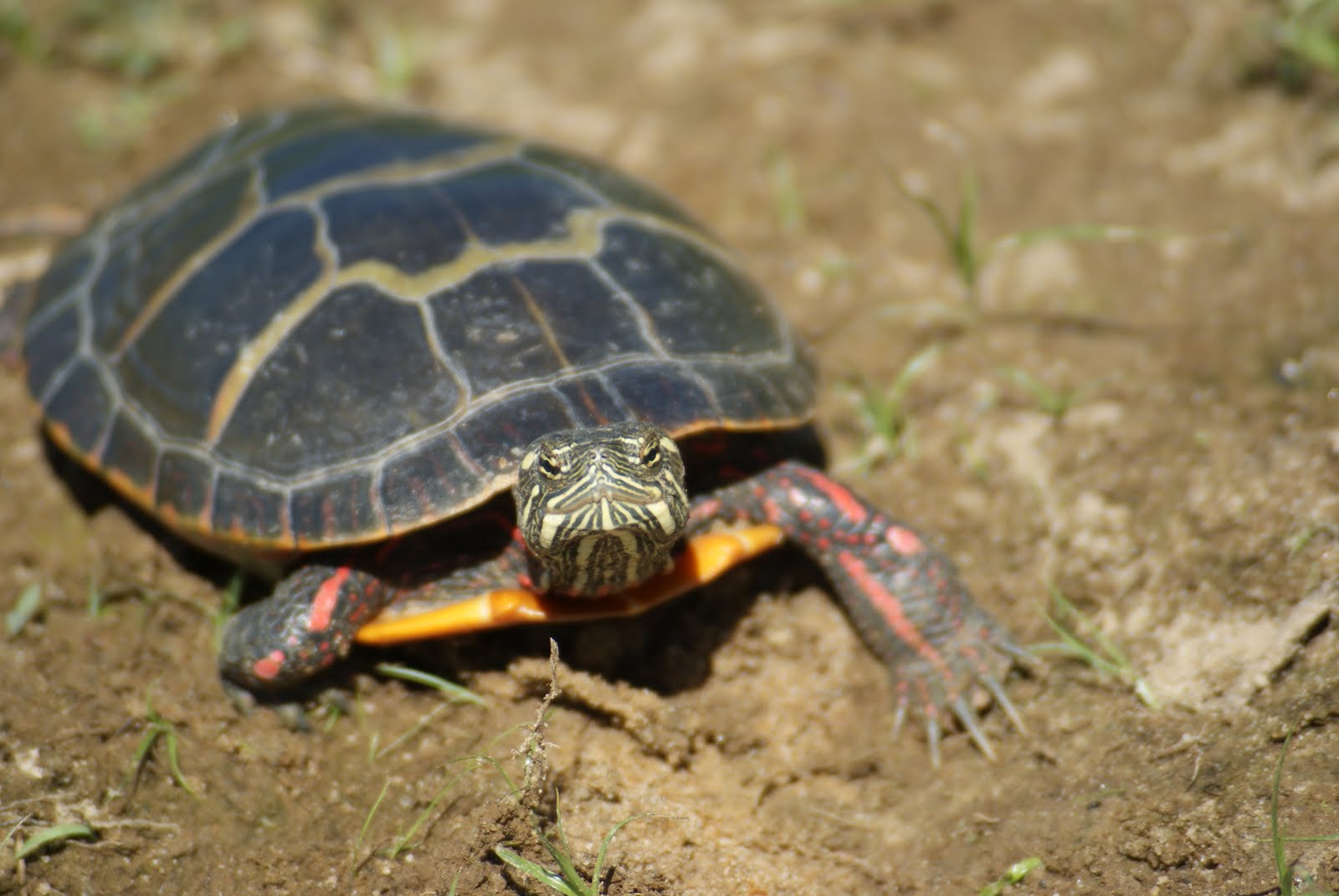
Chino Farm is not just for the birds! A small group of Washington College students, led by Dr. Aaron Krochmal, have been studying the turtles on the property for the past few years. I had the opportunity to talk to Brendyn Meisinger ‘13, a student intern, about his research.

Painted Turtle at Chino Farm
This summer Brendyn put 5 radio transmitters on Eastern Red Painted Turtles so that he could monitor their movements. Brendyn was inspired by some of Dr. Krochmal’s previous research, which examined the potential methods turtles use to find new ponds once the ones they are using have dried up. Brendyn wanted to know how the turtles at Chino Farm find new Delmarva Bays to use during the summer.
What is a Delmarva Bay? You might ask. Well, Delmarva Bays are vernal pools that are something of a mystery to scientists. We do know that they provide essential habitat for a wide variety of reptiles and amphibians. The soil and plant life found in Delmarva Bays are unique. Chino Farm proudly boasts a large number of Delmarva Bays. So much so in fact, that Brendyn was able to pick his own to study and name it whatever he chose. Consequently, Brendyn is studying at “Morrison’s Retreat”, a Delmarva Bay he named after Robert Morrison who founded Phi Delta Theta fraternity.

What do the turtles do once the Delmarva Bays have dried up?
Eventually Brendyn would like to use some of this research for his Senior Capstone Experience, and there’s plenty to go around! This project has many possible directions and students, along with Dr. Krochmal, will hopefully be able to present their findings this coming April at North East Fisheries and Wildlife conference.

Dr. K looks for turtles at Chino Farm
Rachel Field is the Education Coordinator at CES.

Tuesday, August 14, 2012

Searching for Rangia

Our summer began with periodic excursions up and down the mighty Chester River looking for “soft” sediment that we hope to use for characterizing the chemistry of the bottom of Chester River. Why, you might ask? Well, many of the “chemicals of environmental concern”(COEC) are hydrophobic -which literally means afraid of water- but more appropriately reflects the sticky-particle bound nature of many of these contaminants. They don’t like to be dissolved in water, but like to bind to the surfaces of particles and, ultimately, the sediment. Our interest in COECs is directed towards a better understanding of how these chemicals are introduced into the aquatic environment, how they affect resident organisms, and where they may ultimately end up. Anyway, this communiqué is not about COECs but is more about the benthos – the critters that we found in or on the sediment during our summer of mucking about in boats. Overall, we found very little living in the sediments we collected - or more appropriately, very little macro (large, non-microscopic) organisms. For those macro benthic organisms we did find we noted where, when, and what we found; either an occasional oyster, some mussels, and most often – when there was anything – the mighty Rangia.
 This is blog is about the brackish clam,Rangia cuneata (Fig.1); what their role may be in the Chester River ecosystem and whether they might be a good indicator of contaminant exposure and bio-accumulation (accumulation of chemicals in the tissues of the organism) in the Chester.
Fig. 1. Rangia collected from the Chester River about 2 miles south of Chestertown
The Rangia clam, according to information provided by the Maryland Department of the Environment (MDE)1, is a brackish (low salinity) clam that is often found in waters with salinities between 5-15 parts per thousand (fresh water is 0 ppt, ocean water at the mouth of the Chesapeake is ~32 ppt). They often live in highly turbid waters (water that contains a lot of suspended particles, muddy), often preferring soft substrates; usually a sand/mud mixture with vegetation detritus. They are subtidal suspensivores (they filter material out of the water column for food) and are also considered saprophytic, that is they also derive nourishment from dead or decaying organic matter (much like bacteria or fungi). The species found in the Chesapeake are Rangia cuneata and, to this date, the Chesapeake is the northern most reach of their distribution. Apparently, they weren’t always a part of the Chesapeake ecosystem. In fact (according to MDE), the first known sighting of R. cuneata was in 1960 in the Potomac River and are now found in the brackish tributaries and creeks of the upper Chesapeake Bay. Does the timing of their occurrence correspond to increases turbidity in the Chesapeake? Definitely an interesting question…. As a food source for humans, they are considered non-desirable, often because they have an earthy, muddy taste. Investigators from NOAA2 report a very active fishery for Rangia along the east coast of Mexico where they are used as a supplement to local shellfish and fish cuisine, often because they present a less desirable pallet when served alone. In Figure 2, we show where we have found Rangia this summer. The sites where we collected sediment are indicated by black triangles and where we found Rangia clams are shown by the red circles. One hope is that these organisms can help filter and clean the highly turbid waters of the Chester or the even the lower salinity realms of the Bay . Some investigators3 show that Rangia is a good indicator of a system under significant stress; that they represent a situation where other organisms struggle to survive and the ecosystem is in poor health. Rangia are also being investigated as a potential contaminant cleaner-upper for the impact of the BP oil release in the Gulf of Mexico4 Figure 2. Surface sediment grabs sites (black triangles) from the Chester River, summer 2012. The red dots overlay stations where we found Rangia clams.
Fig. 2.
Surface sediment grabs sites (black triangles) from the Chester River, summer 2012. The red dots overlay stations where we found Rangia clams
One of our interests at the Center for the Environment and Society is whether Rangia can serve as biological indicator for contaminant exposure in the Chester River ecosystem. Do contaminants like lead, copper, arsenic and other COEC accumulate in Chester River resident organisms? Is Rangia a potential pathway for the transfer COEC to “higher” organisms that reside in the Chester River ecosystem (e.g., white perch, osprey, humans,etc) where COEC may become further concentrated as they move up the food chain? We don’t know, but we will be measuring the content of some of the COEC in their soft tissues using the relatively new high tech inductively-coupled Mass Spectrometer at Washington College. Stay tuned!


Samuel Hartman, a summer Hodson Fellow, looks to find the optimal site for our next sediment grab
 Christian Krahforst is the Mellon Post Doctoral Fellow of Biogeochemistry for the Center for Environment & Society at Washington College.

1.  http://www.mde.state.md.us/programs/Marylander/CitizensInfoCenterHome/Documents/www.mde.state.md.us/assets/document/Rangia.pdf
2.  http://spo.nmfs.noaa.gov/mfr663/mfr6632.pdf
4.  http://www.nola.com/news/gulf-oil-spill/index.ssf/2011/03/lowly_rangia_clam_as_oil-sucki.html

Friday, July 20, 2012

Part 2: How do People Make Oysters?


UMD HornPoint Laboratories (HPL):  What an operation!  What a facility!  What a weird group of people!  (teasing…)  They started producing baby oysters in 1997.  Last year they produced 650 million spat-on-shell.  In a perfect world with a gentle mother nature, they hope to produce up to 1 billion.  Regardless, HPL is charged with jump-starting the oyster resurgence in Maryland’s Chesapeake.  Currently, our oyster population is at an all time low of 0.03% of historic levels.  The spat-on-shell that comes out of HPL is the seed oyster for our sanctuaries, harvest reserves and burgeoning aquaculture industry.   The Chester has been recipient for decades and most recently received seeded shell for a 2-acre oyster reef spear-headed by the Chesapeake Bay Foundation.

Alright, alright, but how does man make oysters and why is there such a variation in our Marylanders Grow Oyster  (MGO) cages!?  Well, people make oysters by first understanding the science of how oysters reproduce and then they must figure out how they eat.   By inducing female oysters to release eggs and male oysters to release sperm by methodically raising water temperatures, HPL can develop superior gametes from the fittest brood stock—hopefully enhancing the genetic fitness of our native Crassostrea virginica against disease pressure.  Once the gametes meet and form larvae, staff at HPL feed and monitor the microscopic swimmers through various stages of development. So here is how to make oysters:  you have to know how to make algae!  Oyster larvae eat algae, but not just any algae.  Their diet is a well-balanced buffet of different kinds of algae--highly regulated, highly supervised, and highly scientific!


Close monitoring of oyster larvae will reveal the formation of an “eye” or dark speck, that indicates the larvae are ready to set.   Ideally, we want the oysters to “set” on other oyster shells to form a reef, but they will set on anything.    So staff must drain massive tanks filled with millions of larvae before the larvae start attaching themselves to the walls and then……put them in the fridge!  Yup, millions and millions of oyster larvae can be stored right next to last night’s left-overs.    I don’t think there is a shucking knife small enough….

While the larvae are chillin’ out, the staff at HPL readies the setting tanks—located on a state-of-the-art pier that has recently been brought on line.   (Following the logic:  bring the larvae to the water, not the water to the larvae.  Much more cost effective!)  The setting tanks are where the larvae find their new home!   Each tank is filled with aged oyster shell that has been dried and cleaned by the Oyster RecoveryPartnership.  The vast majority of the shell comes from the Chesapeake’s shucking houses but a growing portion is coming from restaurants participating in the Shell Recycling Alliance. (Shameless plug: eat oysters at these restaurants; the shells will go back to the Bay with 10 more oysters attached!)


 Alright, so now we’ve got old oyster shell in water pumped straight from the Choptank River.  When we add eyed larvae looking to set, one precocious little oyster larvae will yell out, “follow me, I know where the prime real estate is!”  And that is when it happens.  Predictably unpredictably, oyster larvae will set in “clusters” on the shell, exhibiting what scientist call a “gregarious setting pattern.”  In other words, they like to grow next to other larvae.  The result is that the spat on shell coming out of the hatchery has a variation in density.  Some shell will have 15 spat attached to it and some shell will have 0 spat set to it.  


When our growers pick up their cages with spat-on-shell randomly distributed, each grower starts off with a different amount of spat to care for.  And then it happens.  Each member has different conditions for caring for our oysters!  It is one of the benefits of the MGO program; oysters come to our member’s home and become a real life aquarium at the end of their piers.  It is also one of the factors influencing the amount of spat on shell that survive the growing season and are planted on a sanctuary.  Each member will have to provide the right amount of care based on his or her water conditions.  That includes suspending the cages at the right depth to avoid lethal blow-out tides in the winter and dunking them periodically to avoid suspended sediments from settling on them to the point of suffocation.  And on top of all of that, we throw in the capriciousness of mother nature!  This past year, we experienced heavy spring rains that came down the mighty Susquehanna and essentially dropped the salinity to 0 at the Bay Bridge for a month or more.  Incredible.  Our spat-on-shell are equally susceptible to the harmful effects of low salinity, but there is little that we can do about that.   Some members that were exposed to the “freshet” coming down the bay experienced very high mortality.  Other growers in Langford Bay didn’t experience much of a difference from last year’s conditions--although there is some discussion that our oysters are a little smaller this year.


The best way to care for our oysters coming out of the hatchery is to follow the recommendations on the MGO website: hang the cages thoughtfully so they are not in the mud, but still underwater during low tides; then dunk them periodically to remove suspended silt--this can be as little as once a month depending on where you are and what time of year its.  But to get the full benefit of the program, don’t be shy about pulling up a cage with a friend or family member to see how the oysters are growing and what critters they have attracted into their mini ecosystem!


Mike Hardesty is Assistant Director of the Chesapeake Semester at Washington College and the MGO-Chester River Coordinator.

Thursday, July 19, 2012

How do People Make Oysters?


Well before we answer that question, let’s talk about how people grow oysters.  In 2008 the MD Department of Natural Resources along with Oyster Recovery Partnership and University of Maryland’s Horn Point Laboratories launched “Marylanders Grow Oysters” (MGO).   In a nut-shell, this is a state funded program that puts oyster restoration into the hands of the thousands of citizens living along the Bay’s shoreline.  It’s local.  It’s community-based, and it's fun!

Our local Chester River-MGO program has been in operation for two seasons now, with great success.  Coordinated by CES and assisted with the help of partner organizations like the Chester River Association, it is 100% dependent upon the sweat equity of thoughtful and energetic community members who want to improve the water quality of the Chester—and learn a little something about oysters as they go.


With 60 members and their family and friends, Chester River-MGO is responsible for 260 cages of baby oysters (spat-on-shell).  Each cage can grow anywhere from 0-300 oysters through our September to June season.   If we get a conservative average of 50 oysters per cage that is still 26,000 oysters a year planted on a local sanctuary in Langford Bay.  Not to mention that we also conspire with MGO programs on the Corsica River and Swan Creek to put oysters back in the Chester. 

This past spring CES organized a survey dive of our sanctuary site.  It was murky, and it was hard to find oysters, but find them we did!  There were at least two distinct “age classes” of oysters: our oysters from 2011 and hatchery oysters from probably around 2009. 


Despite the heavy spring rains from 2011, our oysters were alive and well; we didn’t find any “boxes” or empty oysters that had died.  This came as a great relief to our growers in the Chester as other MGO groups around the Chesapeake had experienced high and unavoidable mortality due to the fresh water coming down from the Susquehanna. (Just in case you are wondering, oysters will grow from around 7ppt salinity to full salt water at 35 ppt.  While many of us like them salty for eating, the high salinity water of our Bay also attracts high disease pressure.  With an average salinity of around 12 ppt towards its mouth, the Chester is a low disease area that lends itself for oyster plantings.)


But let’s back track a little.  “Each cage can grow anywhere from 0-300 oysters….”  That is a huge variation!   Somebody should ask the guy who coordinates this effort what the deal is!  Well, a lot of members did ask me what the deal is, so I punted and said, “we should ask the guy who grows these things what the deal is!”  (Actually, it is a team of people at University of Maryland’s Horn Point Labs and they are dedicated, hard working, and smart.  But are they smarter than mother nature...?)

So instead of watching re-runs of “Freddy vs. Jason” last Friday the 13th,  about fifteen members of Chester River-MGO piled into a Washington College bus and took a field trip to one of the east coast’s largest oyster hatcheries.  (Find out more in Part 2, tomorrow!)


Mike Hardesty is Assistant Director of the Chesapeake Semester at Washington College and the MGO-Chester River Coordinator.

Thursday, July 5, 2012

Boats, Buoys, and Underwater Robots- Oh My..


“Okay, we’re almost on station. Will, get your team in gear,” I offered as Captain Mike eased back on the throttle of the Research Vessel Callinectes. On this third day of the CES GIS Marine Exploration Camp (June 25-29) the students were already in gear. Grab the GPS, the ponar, the clipboard. The Callinectes sidles up to a point selected by the participant team. The captain moves to the back deck pilot station. Dan opens the transom door. Scott (age 17) arms the spring loaded ponar with the jaws open. Jackie (15) notes and records the GPS position from her handheld device and compares it to the boat gps. Will (age 13) lowers the pressure transducer to the bottom and verifies the 24ft depth noted on the ship’s echosounder. Kelsey (15) writes fervently, recording on paper, all of the goings-on and takes pictures of each sample.

Scott lowers the ponar to the Bay floor. He jerks the line a little and feels the jaws of the sampler close. With help from others he hoists the sampler back to the deck, up and over the transom and into the waiting plastic tray. He pushes down on the contraption, the jaws open, and oodles of sediment and stuff pour out. “Rangia,” he exclaims, “I love these Atlantic Rangia.” Will, Jackie, Kelsey, and Scott drop to their knees. Scott describes: “Sandy silt with frequent disarticulated Rangia shells.” He notes that “disarticulated” means that he sees a whole “half” of a clam. It’s not fragmented. Articulated would mean that he’s got both halves, connected as a whole clam, in hand. Sandy-silt means that there is more silt than sand. The Marine Exploration team completes this dance of bottom sampling ten more times up the Chester River from the mouth all the way to Crumpton.

The results of this mapping exercise, along with other day’s experiences building buoys and underwater robots were shared with the entire GIS camp the Saturday after the week-long experience. “This was the best camp experience I’ll have this summer,” exclaimed Will, the team leader of “Will Power” the Camp’s Marine Exploration Team Leader.

GIS Lab
Callinectes

Doug Levin is the Associate Director of the Center for Environment & Society.

Tuesday, June 26, 2012

Messing About in Boats


I have just finished reading the section entitled “messing about in boats” in Tom Horton’s Bay Country (John Hopkins University Press) and was tickled as to how well it captured our summer field work to date.  Our group, which consists of members of CES and WC Depts. of Physics, Biology, Chemistry, and Environmental Studies is interested in understanding how the Chester River ecosystem functions and what state of “health” it is in.  Clearly this pursuit raises a lot of questions and initiates much discussion among our group. (Questions like: How long does the water stay in the Chester?  How much of what is happening in the Chester River is the result of “stuff” happening in the Chesapeake Bay?) So, as a start, we are collecting surface sediment all along the Chester River and will be determining the amount of “things” in it; things like lead, copper, silver, zinc, (and other elements), organic carbon, and what is living in the sediments. Some of what we find may help us reconstruct where the sediments may have come from and where they are accumulating now. Any large organisms we find living in the sediment (benthos) are saved. Later we hope to see if there are any patterns of contaminant accumulation in these organisms. We do all of this by taking a “ponar” grab (see photo) and collecting only the upper 1-2 cm (recent) of surface sediment.  Thus, I have been seeing a lot about this river from the water; trying, similar to John Smith’s agenda, to reach up creek as far as our boats will allow.  And this takes me back to Horton’s “messing about in boats”.  Much of the Bay is very shallow, especially the “upper creek” areas. (..and yes, if you have to ask, I have been stuck a few times and needed to wait for the tide).  One constant throughout this effort is that the Chester River mud is quite messy.  Anyway, here is CES’s progress (via red triangles) on this front so far:


Christian Krahforst is the Mellon Post Doctoral Fellow of Biogeochemistry for the Center for Environment & Society at Washington College.
 

Monday, June 25, 2012

Chester River Association Annual Meeting


Last Thursday, June 21st, the Chester River Association hosted their 2012 Annual Meeting, open to the public.  It was a lovely evening of 100 or so friends, members, board members and colleagues in Washington College’s Casey Academic Center.   I was very pleased to attend both as a colleague from CES and a CRA board member excited to announce our annual Riverkeeper Award recipient.   The evening started off with a warm welcome from Board President, Marcy Ramsey, who immediately recognized the efforts of CRA’s staff.  A special nod went to the work of our newest member and Executive Director, Heather Forsythe.   

CRA’s conservation planner, Paul Spies was next on the line up with a warm welcome and wit for the evening’s keynote speaker, Dr. Josh McGrath, a soil fertility specialist with UMD extension.  As some of you may know, CRA has been promoting a cutting edge precision Ag technology called “Greenseeker.”   Dr. McGrath is a resident expert in Greenseeker technology and is compiling data for CRA’s Greenseeker pilot project.   Essentially, the technology reads exactly how much nitrogen is needed for each corn plant in a farmer’s field as the farmer is applying fertilizer.   Greenseeker communicates to a variable rate fertilizer applicator which does it’s best to apply only what is needed.  There is a little disconnect between the two technologies at this point, but CRA’s pilot project may help to make application more precise.   Dr. McGrath’s point:  if farmers can optimize their fertilizer use from the start—down to the plant!—then we won’t have to spend as much money retroactively remediating our nutrient load issues from the agricultural sector i.e. riparian buffers, cover crops, grass swales, etc.  It’s a win/win/win:  farmer’s spend less, produce more food, and reduce nutrient runoff.   Keeping farms profitable and well managed is a goal for CRA, because it will help keep our water clean.  Precision agriculture is a science-based way to get there. 

For that reason, you won’t be surprised to learn that this year’s Riverkeeper Award went to our very own Chino Farms and Blue Stem Farming Operation!  Dr. Harry Sears, Evan Miles, and their team of dedicated staff have done a fantastic job exemplifying stewardship through precision farming and progressive land conservation.  As the Chester Riverkeeper, David Foster, pointed out, it might be why Foreman’s Branch—the largest creek on Chino—showed a noteworthy resurgence in this past year’s river report card while other creeks declined.   But make no mistake, Chino Farms has been employing cutting edge stewardship, research, and agriculture for many years.  CES is fortunate to have become a part of that commitment and is proud and excited that Chino and Blue Stem have received such a prestigious award!

Mike Hardesty is Assistant Director of the Chesapeake Semester at CES.

To learn more about the Chester River Association visit:

To learn more about Chino Farm’s and CRFRC visit their website at http://www.washcoll.edu/ces/chesterriverfieldresearchcenter/.