Friday, October 12, 2012
Pursuing Beauty
Philosophers have searched for an answer to the question "What is Beauty?" over countless years and from many different perspectives. The veins of a feather, the curve of a wing in flight, or the brush strokes that build a picture? This exhibit explores the question of beauty through the lens of the natural world. Audubon and his colleagues searched to capture the mystery, dignity, and innocence of the creatures that filled their world and often times their bellies. There is a focus in this exhibit on game birds and the practice of sport shooting in the United States. The added dimension of relationship between the subject and the painter creates a more intimate environment. It is almost as if Audubon is glorifying his relationship with the birds he hunts by immortalizing them on the canvas.
The addition of a video by Brian Palmer deepens the reality of the exhibit. The video opens with the stillness of the pre-dawn and follows a day at Foreman's Branch Banding Station. The audience is taken through the bird banding process and given face to face exposure to some of the birds that have inspired these great painters. “To see birds being released, taking wing—it’s the most wonderful thing,” Alex Castro, Curator of the Kohl Gallery, comments. “And at the center of it all, these beautiful still images of birds from the past.”Layering the still photographs with the video of the live birds blurs the line between the paintings and the creatures to create an oasis of wilderness right in the heart of Campus.
The careful and thoughtful planning of Alex Castro and Assistant Curator, Sean Meade, brought this breathtaking vision to fruition. On Tuesday, October 9th dozens of people gathered to celebrate their work at the Exhibit Opening. President Reiss and Dean DiQuinzio, advisor for the Kohl Gallery were present to offer their congratulations and comment on the astounding beauty of this exhibit.
To visit the Kohl Gallery click here.
To visit the Foreman's Branch Bird Observatory click here.
Friday, August 24, 2012
A Week of Warblers!
This past week we got a high number of American Redstarts of all ages and sexes gathered in one area of the study site. Perhaps they are traveling in a group?
We banded 5 Black and White Warblers this week.
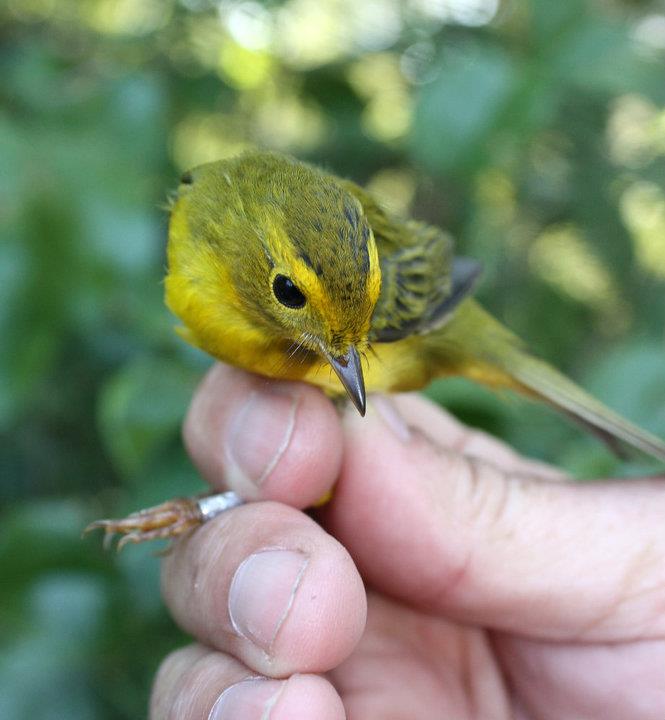
We also got an HY (hatch year) Female Wilson's Warbler this week. You can see that the top of her head is much greener than a male's would be.
This HY Male Blackburnian Warbler was a real treat. We usually only get one a year, and some years we don't get any.
Ok, so this is not a warbler but we broke the record for number of Belted Kingfishers captured this year, and that's pretty neat too!
All signs point to...Migration! Hopefully we'll continue to get interesting and exciting birds in the coming weeks. Be sure to check out day-by-day updates on our facebook page and our weekly banding totals on our Website.
Thursday, August 16, 2012
Turtle Power!
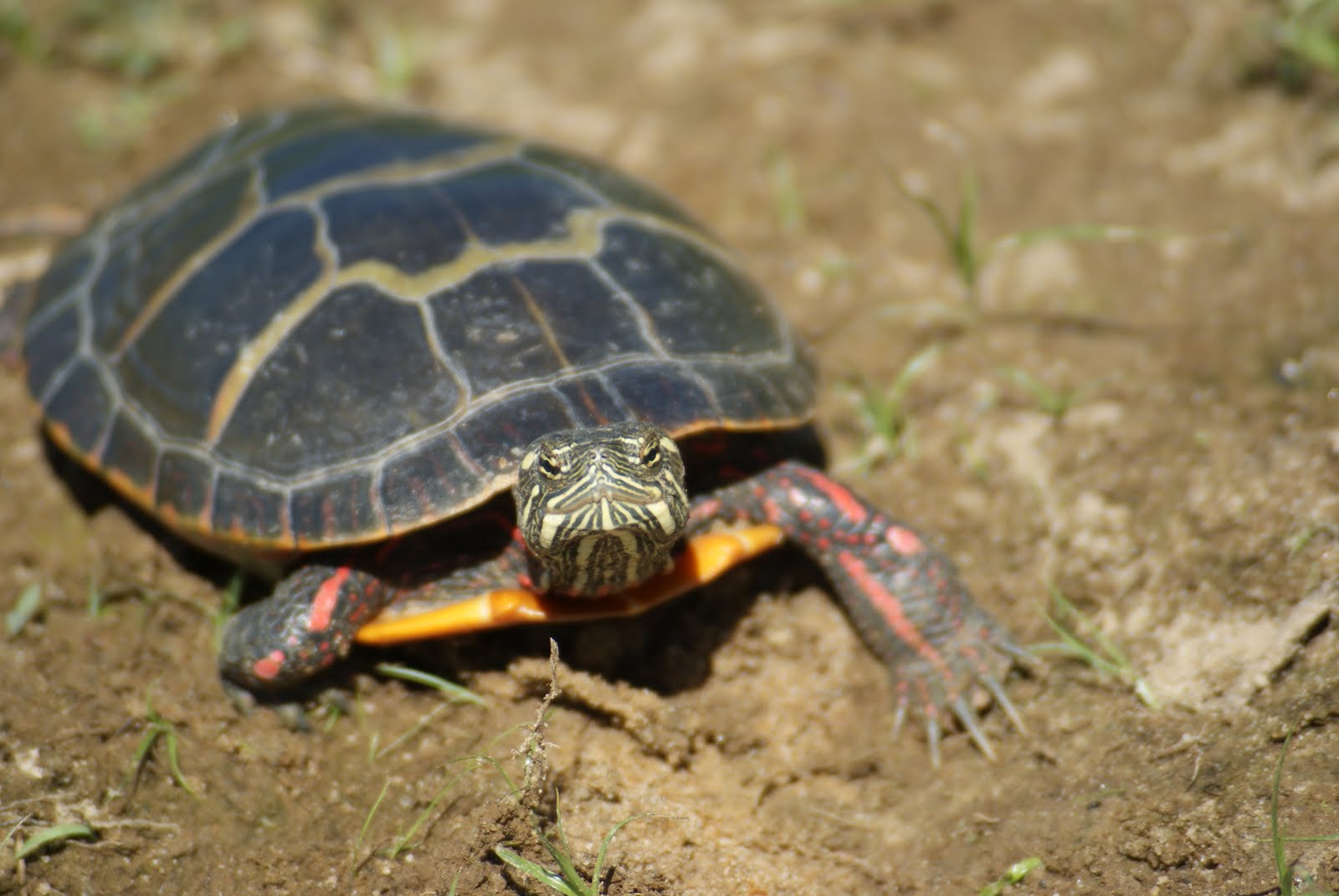
| Painted Turtle at Chino Farm |
What is a Delmarva Bay? You might ask. Well, Delmarva Bays are vernal pools that are something of a mystery to scientists. We do know that they provide essential habitat for a wide variety of reptiles and amphibians. The soil and plant life found in Delmarva Bays are unique. Chino Farm proudly boasts a large number of Delmarva Bays. So much so in fact, that Brendyn was able to pick his own to study and name it whatever he chose. Consequently, Brendyn is studying at “Morrison’s Retreat”, a Delmarva Bay he named after Robert Morrison who founded Phi Delta Theta fraternity.
| What do the turtles do once the Delmarva Bays have dried up? |
| Dr. K looks for turtles at Chino Farm |
Wednesday, August 1, 2012
Other than water, what does the rain bring?
Friday, July 27, 2012
Close Looks at Birds
Well, we've made it through the first stages, and now many of the amazing pictures taken of birds during banding at Foreman's Branch Bird Observatory (FBBO) are available online here. The species are organized by family to the extent possible, though of course some categories have multiple families, and some birds are just hard to categorize. But we've done our best! It was exciting to go through all the pictures that have been taken, and realize first hand the history of the research done at FBBO.
While all of the pictures are impressive, I of course have some favorites, especially the owl and raptor pages. The raptor page is a good example of what we hope to accomplish with these albums. In addition to having a photo of each species, we'd like to show differences between males and females, adults and juveniles, and other variation you might see within the species. At some point we'll also include pictures of the things banders look for when collecting information about these birds. In addition, over time, more information about each species, including information about when certain individuals were caught, data that has been collected on those species, and possibly even sounds will be added to the pages. But all of that, of course, takes time! Not to mention that some of the pictures are, gasp!, on film! All of those will have to await an intern who can scan them in.
Finally, you can also access the albums from our tables of banding data. Now, if you are curious about a species that has been recently banded, you can click on the species name and view photos of that bird.
So as a special bonus for blog readers, here are some photos that didn't make it onto the site (yet!):
| Check out these Kingfisher feet! |
| Most people have never seen this bird- the Common Nighthawk |
![]() |
| Here's its relative, the Whip-poor-will |
| I just can't get enough of this bird, the Pileated Woodpecker |
| Whoa! |
![]() |
| Here's some little screech owls |
| And a little fluffy one |
![]() |
| Sharp-shinned hawk |
![]() |
| And finally, a young Northern Bobwhite |
Tara Holste is the Web Content Manager for the Center for Environment & Society, as well as a recent convert to the world of birding.
Thursday, July 26, 2012
Chino Farm: A Week in Pictures
Bobolinks are officially here to stay. Well...at least to molt. The grasslands are getting filled up with Bobolinks as they feast on foxtail grass and begin their molt before continuing south on migration.
This past week banding on the grasslands jumped in numbers. Among the birds being captured were Orchard Orioles, like this one.
The nesting continues! Grasshopper Sparrows are trying to get one more clutch in before they have to start worrying about migration.
We've been happy to see plenty of young Northern Bobwhite around the grasslands this summer. It seems like they've had a productive breeding season. To check out the latest from the grasslands take a look at our Facebook page.
Next week marks the start of fall banding at FBBO, don't forget to check out our website for the latest updates from the banding station!
Wednesday, July 25, 2012
What's inside that birdhouse?
| Eastern Bluebird nest. The chick is only a few hours old. |
| Carolina Chickadess back in the nest after having been banded. |
Of course, a sturdy, water tight cavity is prime real estate to many animals and not all visitors are birds. Several boxes host Flying Squirrels which we allow to stay. Mice are frequent squatters and we try to discourage them. Sometimes, a birdhouse with eggs inside is a boxed lunch for a raccoon or opossum or a snake. Everything needs to eat.
| Young Black Rat Snake inside what had been a bluebird nest. |
![]() |
| Mice like our birdhouses quite a bit. |
The Tree Swallows have finished nesting for the season, but there are still 3 boxes with House Wren nests and 7 with bluebird nests. Bluebirds can nest quite late into the summer. The latest we’ve had a bluebird fledge on Chino was September 6th! Looks like I have weeks of nest checks still ahead of me. I don’t mind.
Maren Gimpel is a field ecologist at the Chester River Field Research Station. Photos and stories about the goings on of CRFRS can be found at www.facebook.com/crfrc or at www.washcoll.edu/ces/chesterriverfieldresearchcenter
Friday, July 13, 2012
From My Perch
A day at the Custom House always begins with a view of the river. Lucky I am. I try to wrangle all of CES from my desk in the house ... all seven who work in the Custom House and the many others who make vital contributions to our good work from farther afield. You've heard from most of the others. I'm here to make their jobs easier.
All in a day's work.
Jenifer is the Coordinator and Office Manager for the Center for Environment & Society and can be contacted here.
Thursday, July 12, 2012
Summer Scenery at Chino Farm
| Blue Grosbeak Nest |
| Breeding Ovenbirds at FBBO |
| Interns and Guests around the banding truck |
| Field Ecologist Dan Small extracts a bird during banding |
| The long-awaited return of the Bobolinks has finally arrived! |
Monday, July 9, 2012
Monardas of Maryland
| Bee Balm, Monarda didyma. Has brilliant crimson flowers with oval, narrowly pointed and toothed leaves. Found in moist woods, thickets and bottomlands. |
| Purple Bergamot, Monarda media. Purple Flowers with leaves that are oval or broadly triangular. Found in moist woods and thickets. |
| Wild Bergamot, Monarda fitulosa. Pink flowers with narrowly triangular or oval leaves that are pointed and toothed. Upland woods, thickets and prairies. |
| Dotted Monarda, Monarda punctata. Whitish to pink flowers with narrow oval or oblong leaves. Found in dry fields and roadsides. |
![]() |
White Bergamot, Monarda
clinopodia. White flowers with
narrow triangular or oval leaves that are rounded at the base. Found in moist
woods, thickets, ravines and banks. Photo by Homer Price.
|
Monday, July 2, 2012
Friday, June 29, 2012
Lights, Camera, Action!
| Intern Eric Waceiga talks with the film crew. |
| Film intern Harris Allgeier releases a Red-Winged Blackbird. |
To learn more about CRFRS and FBBO check us out on facebook! www.facebook.com/CRFRC
Or take a look at our site on the CES webpage:
www.washcoll.edu/ces/chesterriverfieldresearchcenter
Thursday, June 21, 2012
Bring on the Heat!
![]() |
| Dickcissel decoy for target banding |
![]() |
| Rachel with one of the Osprey chicks |
To learn more about the work at CRFRS in the Grasslands read last week's blog entry: Summer at Chino Farms.
Rachel Field is an intern with CES working with various aspects of the research and administration for Chino Farms/CRFRS.
Wednesday, June 20, 2012
Dream Come True
We’re not just putting these pictures online for the fun of it (though it is fun). Eventually these pictures will become an educational tool- in addition to pictures of each species, there will be pictures of males and females of the same species, close ups showing key features banders use to age each bird, and information about the individuals that were banded at the station. Did you know there’s a Northern Shrike (not at all common on the Eastern Shore of Maryland!) who has returned to Chino Farm for the past six years?
All of this information will be presented along with lesson plans for teachers and guides for using the albums as a resource- for expert banders and researchers from around the world, to bird enthusiasts, to the general public, who, like me, didn’t know a thing about the wide variety of birds that visit us every year!
Warblers Banded at Foreman’s Branch Bird Observatory
Tara Holste is an amateur birder and the web manager for the Center for Environment & Society at Washington College.
Thursday, June 14, 2012
Radio Interviews
Summer at Chino Farms
![]() |
| Summer interns hard at work! |
This summer comes with some exciting new opportunities for research on the Grasslands as well. Former CES summer intern Rachel Field has returned to carry out point counts on the surrounding farms in addition to monitoring the crop fields for GRSPs and surveying the Grasslands to get an understanding of the total number and variety of birds using them. Amanda Spears, a Maryland local attending UVM, has also returned to take charge of FBBO for the summer. Amanda is operating the banding station during the summer months in order to determine what species of birds we have breeding around the banding lab and to get a sense for any birds that FBBO might be missing by closing during the summer months. Amanda has already captured a Blue Winged Warbler and a Mourning Warbler. A very promising start!
![]() |
| Sunrise over the grasslands |
Monday, December 5, 2011
Rare Birds at Chino Farms
Foreman’s Branch Bird Observatory banded and released two "rare" Ash-throated Flycatchers during the fall migration period. A husband and wife team of field ecologists (Dan Small and Maren Gimpel) banded one on November 9th and another on November 30th (pictured at left; photo credit Small and Gimpel 2011). These birds are common west of the Rockies, but they rarely show up in the fall on the East Coast. This species has been documented in Maryland less than 20 times and these are the first to be banded in the state. These individuals are only the 3rd and 4th Ash-throated Flycatchers to be banded on the whole Atlantic flyway.
Birds show up in the "wrong" places from time to time, but there is a theory about the unusually high number of Ash-throated Flycatchers being reported in the East this fall. A bird sightings database run by Cornell University (eBird.org) recently reported on the numerous sightings and proposed that the record-setting drought in Texas and the southern Great Plains had driven these birds from their usual habitats and that the strong recent southwesterly winds have propelled them further East than is normal.
Foreman’s Branch Bird Observatory, under the direction of Jim Gruber, is located at Chino Farms in Queen Anne's County. The observatory and companion field research station is part of Washington College’s Center for Environment & Society. For more information please visit Chester River Field Research Center or contact JoAnn Fairchild Wood at 410-778-7295.