Showing posts with label links. Show all posts

Thursday, July 18, 2013

The Island That Time Forgot


The breeze played on the water and the salt spray washed the faces of the small crew as we headed out into the Miles River. Captain Rich Scofield guided Volunteer out into the water as we began to discuss what we might find on the blob of green that awaited our arrival in the middle of the River. Mike Hardesty, Assistant Director of the Chesapeake Semester and Ben Ford, Special Projects Coordinator, began talking in earnest about what their students might learn from a trip over to Long Point Island. Ecology, history, land-use, and Tom Horton’s book “Bay Country” were all mentioned as they discussed the potential lesson plans that could be developed around this ancient island.
600529_10151531073346262_575847619_n.jpg
Entrance to Long Point Island.
We puttsed up to a small dock on the far shore and Rob Forloney from the Chesapeake Bay Maritime Museum hopped ashore to tie up. As he did, a man started slowly walking toward the dock. “Hi. You must be the group from Washington College” he said as he approached the boat. He introduced himself as Jimmy Rouse, the owner of Long Point Island. As we all hopped back in the boat and started out for the Island, Jimmy began to tell stories of growing up on that Island. “We spent summers out here. There were three huge black walnut trees that we sold for lumber…we used the money from those trees to build the bulkheads…My father and his brothers build the cabins themselves.” Jimmy told us that he remembers when the island was connected to the mainland. In fact his family supervised driving bulldozers across the narrow land bridge onto the island for agricultural purposes.
Finally we bumped up against the dock and hopped onto shore. In front of us was a beautiful wooden cabin nestled under a canopy of mature oaks and pines. I could just imagine Thoreau walking out of the front door and sauntering off through the trees. “We can have this fixed up,” Jimmy’s wife said as we walked through the front door of the cabin. Mike immediately started pacing around happy as a kid in a candy shop, or as an environmentalist in a cabin in the woods. I could hear snippets of excited mutterings concerning team building and campfires. As my eyes drifted from the windows to the trees I couldn’t help but wondering about the incredible stories a place like this would hold. Cutoff from the mainland for over a hundred years, farmed until the 1920’s and then logged in the 1970’s, some of these trees had seen it all. The entire history of western civilization locked away in the rings of the white oak that swayed silently in the summer breeze. They had seen farmers tear up the soil to put in irrigation ditches. They had seen loggers tear down huge black walnut trees leaving gaping wounds in the canopy. They had seen children racing through the woods, combing the beaches for arrowheads, and studying the birds as they hopped through the undergrowth. Now they were watching a new group move through. A group that would fill the air with campfire smoke, good whole-body laughs, and exclamations of wonder and discovery.
1069921_10151531073776262_1465923606_n.jpg
The CES crew explores the forest on Long Point Island.
“Would you like to walk the length of the island?” Jimmy asked. Between the cabin and the far beach we discussed the history of the land at length. We were immersed in a discussion about the evolution of agriculture in the Chesapeake Bay region when we were interrupted by a Velociraptor. Well, at least it sounded like a Velociraptor, but after a little bit of searching we discovered that there was a heron rookery on the island.  For the next few minutes we watched as adult herons went to and from the nest bringing food for their young. In the distance we could hear the plaintive chirping of Osprey and Eagles. Beneath our feet the spent bodies of horseshoe crabs reminded us of the passing of the seasons, and brought us back to the task at hand. It might’ve been then, maybe it was while we were looking for raspberry bushes in one of the tangles of underbrush, or it might’ve been when we were all sitting on the porch of one of the cabins talking about the challenges and changes of the Chesapeake. Regardless of when it happened, we didn’t notice it until we were all loaded back on the boat and we began thinking about getting home that Rob said, “I think my watch stopped!”
None of us could figure out why that might’ve happened at the time, but I think now that I know the answer. I don’t think anything went wrong; I think that the Chesapeake, for just a brief moment, managed to break through all of our planning and give us an invitation. The Chesapeake called us with herons, the circling Osprey, the bodies of horseshoe crabs, and the slow march of box turtles.  For those of us who were there and for the students who will arrive there in a few short weeks with the Chesapeake Semester, Long Point Island will always be a place to stand still. A place to let the Chesapeake lap the soles of your feet and the quiet oaks shelter you, beckoning your return to peace, quiet, and good earth. 
946580_10151531073701262_1960298862_n.jpg
Ben's box turtle.
This article was written by Rachel Field, Program and Intern Coordinator for the Center for Environment & Society.

Friday, July 12, 2013

Pilgrim on Radcliffe Creek

Arial view of Radcliffe Creek
Despite the time that I have spent in Chestertown as a student of Washington College, it was not until about two months ago that I first heard of Radcliffe Creek. Even as an Environmental Studies major, this creek was something that I had not been introduced to in my two years in school. As I began to research the history of the creek and its watershed, I met with some members from the town who are currently planning the construction of three retention pools at the source of Radcliffe Creek. Radcliffe Creek begins to form very near to the LaMotte building and the Acme shopping center on Route 213. The mouth of the creek is roughly a quarter mile from the Boat House on South Cross Street and feeds directly into the Chester River. Radcliffe Creek was identified as an area of impaired water in the Middle Chester River Restoration Action Strategy (MD DNR 2002) and the purpose of these retention pools is to help improve the water and habitat quality of Radcliffe so that it may no longer be considered impaired. During my research it was discovered that there used to be an old dumpsite in an area just south of Cromwell Clark Road. Additionally, there was a coal/gas manufacturing plant located on 813 West High Street—an area that backs up directly to Radcliffe Creek—that operated from 1910 to 1946. After these discoveries, the idea of performing sediment sampling and trace metal testing in addition to nutrient and water quality testing became much more prevalent. The creek itself is primarily fed by ground water and storm water runoff and has very low salinity (the average salinity of the creek is a mere 0.2 ppt). The plant life within the creek consists mostly of phragmites but there are healthy strands of cattails amongst the phragmites in addition to some forest vegetation along some of the banks of the creek.
Osprey with dinner

The times that I have kayaked along the creek I have seen numerous Ospreys, Red-winged Black Birds, Great Blue Herons, two muskrats, a few turtles (I was not able to get close enough to determine the type of turtle), and some very small fish. The creek itself has high potential to become a fantastic area for wildlife, as it is already home to many different types of organisms. Since there had been no prior delineation of it, one of the first things that I began doing when I found out about Radcliffe Creek was delineate its watershed in order to get an idea of the land that contributes to its runoff. I also went out on the creek and measured various depths of Radcliffe so that a 3D bathymetric model of the creek can be produced at some point. Since there has been virtually no research conducted on Radcliffe Creek, there is a lot to catch up on and even more to pursue. My primary focus for the past two months has been to test the overall water quality of Radcliffe. I perform biweekly surveys of the creek and measure temperature, salinity, dissolved oxygen (both in mg/L and % saturation), Chlorophyll a and pH using a water quality sonde. I also take water samples from four different sites along the creek and use them to test for ammonia, nitrate, orthophosphate, total nitrogen and total phosphorus. The average amount of total nitrogen within the creek has been 2.5 mg/L and the average total phosphorus is 0.26 mg/L which produces a nitrogen (N) to phosphorus (P) ratio of about 10 to 1 rather than the16 to 1 that is typically needed for phytoplankton. (This means that for every atom of P used a phytoplankton cell needs 16 atoms of N – on average). It appears that N may be limiting phytoplankton growth, at least for the short period of time that I have been investigating the Radcliffe Creek water quality.
Students paddling on Radcliff Creek
My hope is that this research and data collection will be able to continue over the years so that a better understanding of the ecosystem quality of Radcliffe Creek emerges. Radcliffe has huge potential to become an even more wonderful and habitable creek than it is currently and my hope is that by raising awareness and learning more about the charming creek, Radcliffe will become one of the gems of Chestertown. I would like to thank all of the people who have helped me with this research—my fellow students Sarah Winters, Olivia Hughes and Rachel Stoddard and professors Christian Krahforst, Leslie Sherman and Karl Kehm. I would not have been able to do this without their fantastic efforts.

Drew Hobbs is an Environmental Studies major with minors in Computer Science and Chemistry. He will be starting his Junior year at Washington College in the fall.

Monday, October 29, 2012

Sandy Visits Downrigging Weekend

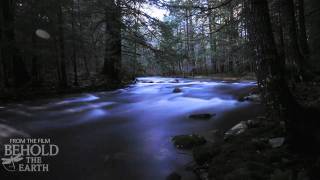
Photo courtesy of "Behold the Earth"
This past weekend some of us were priveledged to hear David Conover and Tim Eriksen present at the Prince Theater. Conover spoke of the intersection between society and nature that he explores in his forthcoming documentary "Behold the Earth." In this film Conover uses breathtaking scenery, haunting folk melodies, and poignant interviews to explore America's divorce from nature. While sitting in my house this morning watching the trees groan in the winds of Hurricane Sandy, I couldn't help but hear the soulful notes of Eriksen's song "Every Sound Below" and consider the power of this storm.
Rain lashing, candles sputtering, birds calling, the street cleaner slowly driving by. These were the sounds reaching through my "cocoon." Conover described Americans as a people who travel between a series of cocoons, forgetting to spend time outside of our meticulously managed environments. Today, Sandy is forcing the people on the east coast out of their cocoons.
Satellite image of Hurricane Sandy

Since agriculture became the modus operandi for humankind we have slowly moved to create more distance between ourselves and our surroundings. This process was much enhanced by the dawn of the technological era. Humans now have so much power over their environment that some suggest we have entered an "anthropocene," or geological period defined by human action disrupting the surface of the Earth. Socially this technology has moved children away from the outdoors and in front of screens. Conover noted that in the last decade children have spent an average of over 7 hours a day in front of a screen.
Photo courtesy of "Behold the Earth"

Conover does not seek to provide a particular answer to this problem, rather he is making an attempt to understand why our divorce from nature started and exactly what that divorce looks like. The fierce embrace of Hurricane Sandy brings this question right into our homes, through leaky windows, flooded basements, and loss of power: electrical and otherwise.

Tuesday, October 23, 2012

Science and Art: Understanding our Relationship with the Environment

     This past week the Center for Environment and Society proudly sponsored two lectures. The first was given by John Beardsley of Dumbarton Oaks and titled, “Art in the Environment: Sketches from the Field.” On the following night, the very day of it’s inception 40 years ago, Tom Horton discussed the Clean Water Act with a lecture titled, “40 Years of the Clean Water Act Through the Lens of the Chesapeake Bay.” The succession of these two lectures beautifully reflects the mission of the Center for Environment and Society. First, Beardlsey discussed the tension expressed by 19th century nature artists who represented the conflict between viewing the landscape with an artists’ eye as opposed to a developers. Beardsley went on to describe the 20th century movement he describes as the second era of nature art. Now we see a movement toward manipulating the environment to make powerful statements about beauty, purpose, and our relationship with the natural world.
Lightning Field, New Mexico by Walter DeMaria
     Beardsley ended his talk with a discussion of the benefits of a union between artistic and ecological pursuits. It is common practice to use art as a meditative or therapeutic exercise. Beardsley suggested that this practice could be applied to the broader relationship between all human beings and the natural world. In many ways Horton echoed this message the following evening with his call for a broader approach to conservation.
     Horton summarized many of the successes and the setbacks that have been a part of the history of the Clean Water Act. With population levels rising in the Chesapeake Bay region the amount of nutrient runoff and waste is increasing at enormous levels despite our best efforts. Horton mentioned the change from a wild oyster harvest to a system in which oysters are farmed as an example of one way that life in the Chesapeake Bay has changed. By encouraging interdisciplinary approaches, thorough scientific analysis, and community-based efforts, Horton believes that we will be able to keep improving the state of the Bay.
     Both Beardsley and Horton reminded their audiences that only by working together from many different perspectives do we have a chance of making real progress and saving the land that sustains us.
Foreman's Branch of the Chester River

Friday, October 12, 2012

Pursuing Beauty

This past week the Kohl Gallery opened an exquisite exhibit entitled "In Pursuit of Beauty: John J. Audubon and the Golden Age of Bird Illustration." This exhibit features works from Audubon, but also includes prints from William Beebe, Charles Lucien Bonaparte, Daniel Giraud Elliot, John Gould, and Alexander Wilson. The exhibit is scheduled to run until Friday, November 30th and is open Wednesday through Sunday 1-6 pm.

Philosophers have searched for an answer to the question "What is Beauty?" over countless years and from many different perspectives. The veins of a feather, the curve of a wing in flight, or the brush strokes that build a picture? This exhibit explores the question of beauty through the lens of the natural world. Audubon and his colleagues searched to capture the mystery, dignity, and innocence of the creatures that filled their world and often times their bellies. There is a focus in this exhibit on game birds and the practice of sport shooting in the United States. The added dimension of relationship between the subject and the painter creates a more intimate environment. It is almost as if Audubon is glorifying his relationship with the birds he hunts by immortalizing them on the canvas.

The addition of a video by Brian Palmer deepens the reality of the exhibit. The video opens with the stillness of the pre-dawn and follows a day at Foreman's Branch Banding Station. The audience is taken through the bird banding process and given face to face exposure to some of the birds that have inspired these great painters. “To see birds being released, taking wing—it’s the most wonderful thing,” Alex Castro, Curator of the Kohl Gallery, comments. “And at the center of it all, these beautiful still images of birds from the past.”Layering the still photographs with the video of the live birds blurs the line between the paintings and the creatures to create an oasis of wilderness right in the heart of Campus.
The careful and thoughtful planning of Alex Castro and Assistant Curator, Sean Meade, brought this breathtaking vision to fruition. On Tuesday, October 9th dozens of people gathered to celebrate their work at the Exhibit Opening. President Reiss and Dean DiQuinzio, advisor for the Kohl Gallery were present to offer their congratulations and comment on the astounding beauty of this exhibit.

To visit the Kohl Gallery click here.
To visit the Foreman's Branch Bird Observatory click here.

Tuesday, September 25, 2012

Waterfront Festival 2012!

Check out this video of the Waterfront festival! Filmed by Brian Palmer and Eric Broussard of Washington College. Students, staff, faculty, and community members turned out on Saturday for a beautiful day of fun on the Chester River. This year featured:
Free boat rides on the Callinectes
Sailing and kayaking on the Chester River
Model Boat Building
Pony Rides
Scales & Tails
the "Fishmobile"
and many more wonderful activities for the whole family!
Of course, the highlight of the day was the Cardboard Boat Regatta. We had many brave competitors this year, but sleek design and excellent construction brought Captain Brian Palmer of "Chessie Racing" the Cape Horn award for first around the course. Our own "Chesapeake Semester" boat Captained by Mike Hardesty, made it around the course for second place. "No Place like Home" followed closely behind for third place. The coveted People's Choice Award also went to "No Place like Home." There was no surprise that the Cutty Sark Award for best design went to "Chessie Racing," and it was also no surprise that "No Place like Home" won Best Theme & Costumes! For their innovative method of swimming their boat around the course and their exceptional team spirit, "Chariots of Fire" took home the Linda Greenlaw Award. The final award of the day went to "Dance to your own Tune" who, in a heart-wrenching display of teamwork, dragged their boat around the course after it sank on the starting line. All of our competitors were wonderful, and we look forward to seeing YOU on the water next year at the 2013 Waterfront Festival and Cardboard Boat Race!

Friday, August 24, 2012

A Week of Warblers!

This past week at the banding station was filled with exciting warblers! Here are some pictures of the best and the brightest. Also check out our weekly banding totals for a more detailed look at what we've been catching at Foreman's Branch Bird Observatory.
This past week we got a high number of American Redstarts of all ages and sexes gathered in one area of the study site. Perhaps they are traveling in a group?
We banded 5 Black and White Warblers this week.
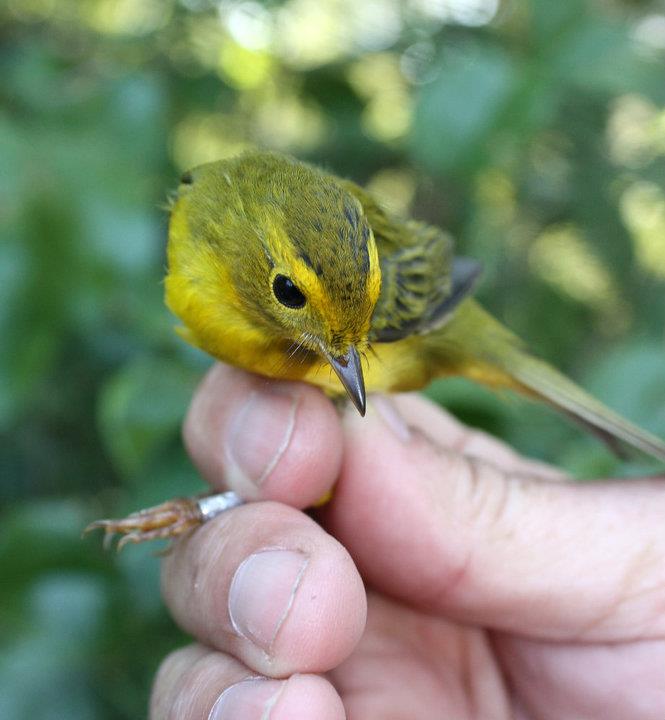
We also got an HY (hatch year) Female Wilson's Warbler this week. You can see that the top of her head is much greener than a male's would be.
This HY Male Blackburnian Warbler was a real treat. We usually only get one a year, and some years we don't get any.
Ok, so this is not a warbler but we broke the record for number of Belted Kingfishers captured this year, and that's pretty neat too!
All signs point to...Migration! Hopefully we'll continue to get interesting and exciting birds in the coming weeks. Be sure to check out day-by-day updates on our facebook page and our weekly banding totals on our Website.

Thursday, August 16, 2012

Turtle Power!

Chino Farm is not just for the birds! A small group of Washington College students, led by Dr. Aaron Krochmal, have been studying the turtles on the property for the past few years. I had the opportunity to talk to Brendyn Meisinger ‘13, a student intern, about his research.

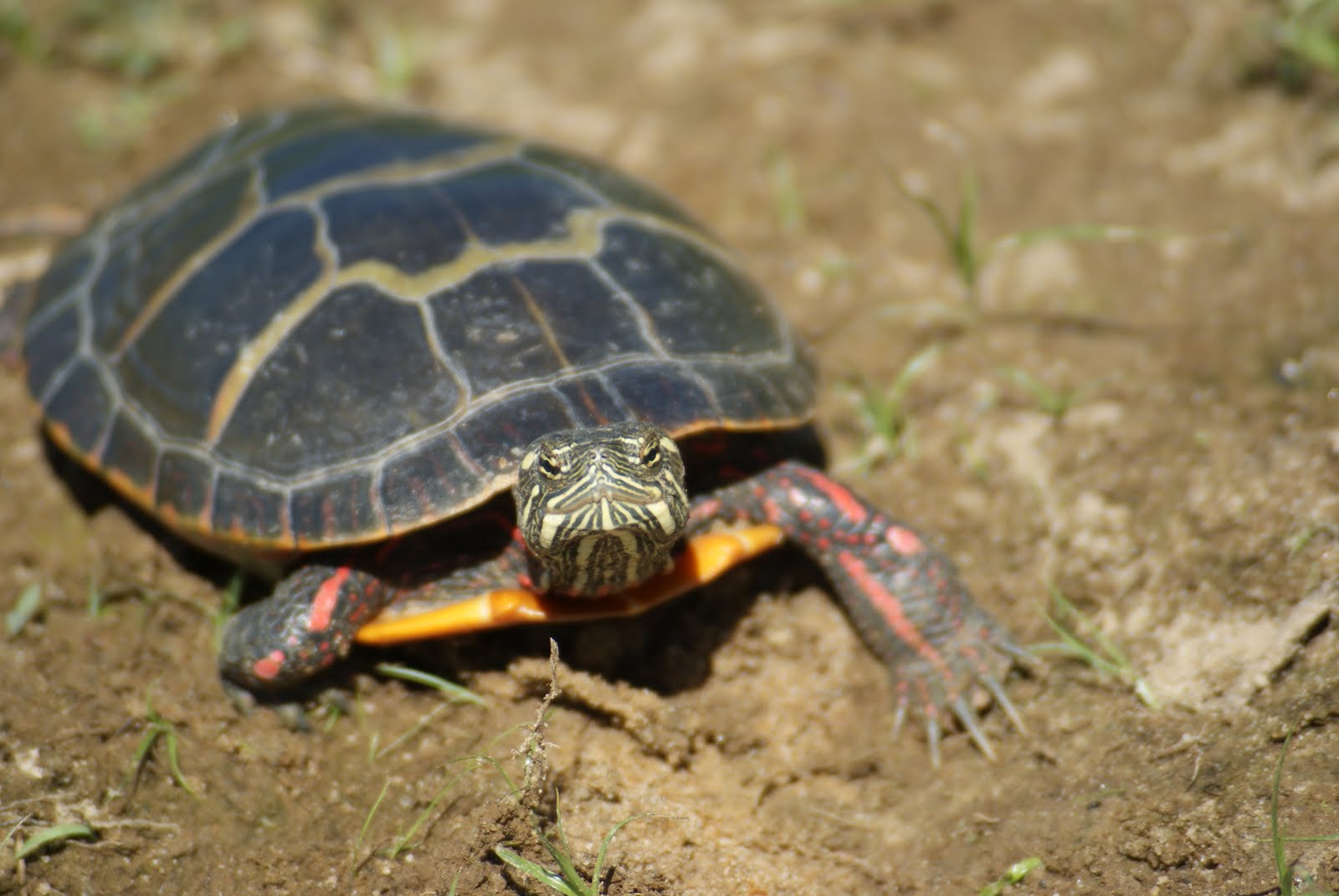
Painted Turtle at Chino Farm
This summer Brendyn put 5 radio transmitters on Eastern Red Painted Turtles so that he could monitor their movements. Brendyn was inspired by some of Dr. Krochmal’s previous research, which examined the potential methods turtles use to find new ponds once the ones they are using have dried up. Brendyn wanted to know how the turtles at Chino Farm find new Delmarva Bays to use during the summer.
What is a Delmarva Bay? You might ask. Well, Delmarva Bays are vernal pools that are something of a mystery to scientists. We do know that they provide essential habitat for a wide variety of reptiles and amphibians. The soil and plant life found in Delmarva Bays are unique. Chino Farm proudly boasts a large number of Delmarva Bays. So much so in fact, that Brendyn was able to pick his own to study and name it whatever he chose. Consequently, Brendyn is studying at “Morrison’s Retreat”, a Delmarva Bay he named after Robert Morrison who founded Phi Delta Theta fraternity.

What do the turtles do once the Delmarva Bays have dried up?
Eventually Brendyn would like to use some of this research for his Senior Capstone Experience, and there’s plenty to go around! This project has many possible directions and students, along with Dr. Krochmal, will hopefully be able to present their findings this coming April at North East Fisheries and Wildlife conference.

Dr. K looks for turtles at Chino Farm
Rachel Field is the Education Coordinator at CES.

Tuesday, August 14, 2012

Searching for Rangia

Our summer began with periodic excursions up and down the mighty Chester River looking for “soft” sediment that we hope to use for characterizing the chemistry of the bottom of Chester River. Why, you might ask? Well, many of the “chemicals of environmental concern”(COEC) are hydrophobic -which literally means afraid of water- but more appropriately reflects the sticky-particle bound nature of many of these contaminants. They don’t like to be dissolved in water, but like to bind to the surfaces of particles and, ultimately, the sediment. Our interest in COECs is directed towards a better understanding of how these chemicals are introduced into the aquatic environment, how they affect resident organisms, and where they may ultimately end up. Anyway, this communiqué is not about COECs but is more about the benthos – the critters that we found in or on the sediment during our summer of mucking about in boats. Overall, we found very little living in the sediments we collected - or more appropriately, very little macro (large, non-microscopic) organisms. For those macro benthic organisms we did find we noted where, when, and what we found; either an occasional oyster, some mussels, and most often – when there was anything – the mighty Rangia.
 This is blog is about the brackish clam,Rangia cuneata (Fig.1); what their role may be in the Chester River ecosystem and whether they might be a good indicator of contaminant exposure and bio-accumulation (accumulation of chemicals in the tissues of the organism) in the Chester.
Fig. 1. Rangia collected from the Chester River about 2 miles south of Chestertown
The Rangia clam, according to information provided by the Maryland Department of the Environment (MDE)1, is a brackish (low salinity) clam that is often found in waters with salinities between 5-15 parts per thousand (fresh water is 0 ppt, ocean water at the mouth of the Chesapeake is ~32 ppt). They often live in highly turbid waters (water that contains a lot of suspended particles, muddy), often preferring soft substrates; usually a sand/mud mixture with vegetation detritus. They are subtidal suspensivores (they filter material out of the water column for food) and are also considered saprophytic, that is they also derive nourishment from dead or decaying organic matter (much like bacteria or fungi). The species found in the Chesapeake are Rangia cuneata and, to this date, the Chesapeake is the northern most reach of their distribution. Apparently, they weren’t always a part of the Chesapeake ecosystem. In fact (according to MDE), the first known sighting of R. cuneata was in 1960 in the Potomac River and are now found in the brackish tributaries and creeks of the upper Chesapeake Bay. Does the timing of their occurrence correspond to increases turbidity in the Chesapeake? Definitely an interesting question…. As a food source for humans, they are considered non-desirable, often because they have an earthy, muddy taste. Investigators from NOAA2 report a very active fishery for Rangia along the east coast of Mexico where they are used as a supplement to local shellfish and fish cuisine, often because they present a less desirable pallet when served alone. In Figure 2, we show where we have found Rangia this summer. The sites where we collected sediment are indicated by black triangles and where we found Rangia clams are shown by the red circles. One hope is that these organisms can help filter and clean the highly turbid waters of the Chester or the even the lower salinity realms of the Bay . Some investigators3 show that Rangia is a good indicator of a system under significant stress; that they represent a situation where other organisms struggle to survive and the ecosystem is in poor health. Rangia are also being investigated as a potential contaminant cleaner-upper for the impact of the BP oil release in the Gulf of Mexico4 Figure 2. Surface sediment grabs sites (black triangles) from the Chester River, summer 2012. The red dots overlay stations where we found Rangia clams.
Fig. 2.
Surface sediment grabs sites (black triangles) from the Chester River, summer 2012. The red dots overlay stations where we found Rangia clams
One of our interests at the Center for the Environment and Society is whether Rangia can serve as biological indicator for contaminant exposure in the Chester River ecosystem. Do contaminants like lead, copper, arsenic and other COEC accumulate in Chester River resident organisms? Is Rangia a potential pathway for the transfer COEC to “higher” organisms that reside in the Chester River ecosystem (e.g., white perch, osprey, humans,etc) where COEC may become further concentrated as they move up the food chain? We don’t know, but we will be measuring the content of some of the COEC in their soft tissues using the relatively new high tech inductively-coupled Mass Spectrometer at Washington College. Stay tuned!


Samuel Hartman, a summer Hodson Fellow, looks to find the optimal site for our next sediment grab
 Christian Krahforst is the Mellon Post Doctoral Fellow of Biogeochemistry for the Center for Environment & Society at Washington College.

1.  http://www.mde.state.md.us/programs/Marylander/CitizensInfoCenterHome/Documents/www.mde.state.md.us/assets/document/Rangia.pdf
2.  http://spo.nmfs.noaa.gov/mfr663/mfr6632.pdf
4.  http://www.nola.com/news/gulf-oil-spill/index.ssf/2011/03/lowly_rangia_clam_as_oil-sucki.html

Friday, August 10, 2012

Barnyard Olympics!

What do cows, chickens, sheep, pigs, horses, goats and "loco llamas" all have in common? The Queen Anne's County Fair, going on this week, at the 4-H Park on Route 18 in Centreville, MD. At 5:00 PM today (8/11/12) you can catch jousting, the state sport of Maryland. You won't believe the speed these junior and senior riders have when they lance rings no bigger than what is holding up your shower curtain. Then at 7:00 PM there's the Farm-to-Market auction and the 4-H kids finally see a profit for all their work tending animals. The Queen Anne's Fair is even better than the Devon Horse Show in my opinion. So bring the whole family tonight and celebrate 70 years of 4-H on the Eastern Shore. Or come on Saturday for the rodeo at 5:00 PM. After that, you'll be counting down the days until next year's community fair. Admission is $3.
JoAnn Fairchild, senior program manager at CES, lives outside of Centreville in an 1880s farmhouse with her husband, two horses, two dogs and two cats - for now. After seeing the miniature donkey and horses at the QA County Fair, the family plans to add a few more animals this fall.

Thursday, July 26, 2012

Chino Farm: A Week in Pictures

This week at the banding station Amanda Spears caught one of the first migrants of the season: a Black and White Warbler!
Bobolinks are officially here to stay. Well...at least to molt. The grasslands are getting filled up with Bobolinks as they feast on foxtail grass and begin their molt before continuing south on migration.
This past week banding on the grasslands jumped in numbers. Among the birds being captured were Orchard Orioles, like this one.
The nesting continues! Grasshopper Sparrows are trying to get one more clutch in before they have to start worrying about migration.
We've been happy to see plenty of young Northern Bobwhite around the grasslands this summer. It seems like they've had a productive breeding season. To check out the latest from the grasslands take a look at our Facebook page.
Next week marks the start of fall banding at FBBO, don't forget to check out our website for the latest updates from the banding station!

Thursday, July 12, 2012

Summer Scenery at Chino Farm

Even in the heat, it's a lot of fun being outside all day surrounded by animals and plants. Here are some highlights from the Chester River Field Research Station this past week!
Blue Grosbeak Nest

Breeding Ovenbirds at FBBO

Interns and Guests around the  banding truck
Field Ecologist Dan Small extracts a bird during banding
The long-awaited return of the Bobolinks has finally arrived! 
Don't forget to check out the latest from CRFRS and FBBO on the website and facebook pages!

Thursday, June 21, 2012

Bring on the Heat!


The temperatures are rising, but the summer fun continues at Chino! Over at the banding station Amanda Spears, summer CES intern, is capturing a steady amount of birds and managing to avoid the heat so far. During the rain day last week she was able to start some statistical analysis of the banding data, putting her college statistics course to good use! Over in the grasslands at CRFRS the interns are forging ahead with territory mapping and nest searching. On Wednesday June 13th the interns found a whopping total of 3 Dickcissel nests. This past week marked the beginning of bi-weekly surveys of the grasslands conducted by Maren Gimpel, field ecologist, and Rachel Field, CES intern. These data will help develop an understanding of the variety and volume of birds using the grasslands during the breeding season.
Dickcissel decoy for target banding
Dan Small, field ecologist, banded last week along with Jeff Sullivan, summer CES intern, (in between the rainy and windy days) and they were catching a good number of Orchard Orioles. They also put color bands on plenty of Grasshopper and Field Sparrows! Dan is once again engaged in a battle of wits against the male Dickcissels, who are proving to be the most challenging grassland bird to target band. Target banding involves setting up one or two nets in the hopes of catching a specific bird to be color banded. Maybe the latest decoy will tempt some of the males to fly into the nets?
Rachel with one of the Osprey chicks
Over the weekend intrepid volunteers gathered at Chino for the annual Osprey banding effort. Under the direction of long-time volunteer Bill Snyder and bander Jim Gruber, the team went around the farm to the various Osprey platforms and banded the young from the nests. Osprey banding has been carried out on the farm since 1998 and we have banded over 80 individuals. Some of our Osprey have been recovered very far from home. In 2002 one of our Osprey was found shot in Trinidad, and in 2008 another was found in Ecuador. Check out pictures from Osprey banding on CRFRS's Facebook page.
To learn more  about the work at CRFRS in the Grasslands read last week's blog entry: Summer at Chino Farms
Rachel Field is an intern with CES working with various aspects of the research and administration for Chino Farms/CRFRS.

Wednesday, June 20, 2012

Dream Come True

Lately I’ve been fortunate to have what I think of as a dream project- I’ve been going through all the pictures of birds taken at Foreman’s Branch Bird Observatory in an effort to put at least one picture of every bird up on the website. This may not sound like a dream project to most people- I mean, it’s just endlessly going through pictures of birds and resizing them, right? And with around 190 species banded at the station over the years, it’s quite a lot of pictures.
No, the reason it’s a dream job is because I’ve become a birder. Three years ago I met my partner, incidentally a former CRFRC employee and bander, and he of course had to get me hooked. At first I was reluctant- I mean, birding, right? People make fun of that hobby. But I’ve always enjoyed being outdoors and for me birding meant a deeper understanding of what I was seeing as I hiked around- it literally opened my eyes to things I never even knew were there. Now my own personal life list is hovering around 175, and it’s time to start really firming up my knowledge of birds. By sorting through these pictures and posting them, I get to not only test my knowledge (is that a Canada warbler or a Cape May warbler?), I also get to see the other birds I need to keep a look out for when I’m out and about. My identification skills have improved by leaps and bounds just in the last few weeks.
We’re not just putting these pictures online for the fun of it (though it is fun). Eventually these pictures will become an educational tool- in addition to pictures of each species, there will be pictures of males and females of the same species, close ups showing key features banders use to age each bird, and information about the individuals that were banded at the station. Did you know there’s a Northern Shrike (not at all common on the Eastern Shore of Maryland!) who has returned to Chino Farm for the past six years?

All of this information will be presented along with lesson plans for teachers and guides for using the albums as a resource- for expert banders and researchers from around the world, to bird enthusiasts, to the general public, who, like me, didn’t know a thing about the wide variety of birds that visit us every year!
The albums are still under development, but I’ll give you a sneak peek, just to whet your appetite. Stay tuned for further developments, and be sure to check out up to the minute photos of birds being banded at the Chester River Field Research Center facebook page.
Warblers Banded at Foreman’s Branch Bird Observatory
Tara Holste is an amateur birder and the web manager for the Center for Environment & Society at Washington College.

Monday, June 4, 2012

Dr. Harry Sears Interview

Catch Dr. Harry Sears and Dr. Doug Gill of Chino Farms on "BirdNote." On WAMU, BirdNote is broadcast several times a month during "Animal House", an hour-long newsmagazine program about animals of all kinds. It airs on Saturdays starting at 12 noon. Click here to find out more about the show. Click here for a preview of the show with Dr. Sears, which will air this Thursday, June 7.

Friday, May 25, 2012

Dr. Harry Sears and Dr. Doug Gill on Bird Note

Catch Dr. Harry Sears and Dr. Doug Gill of Chino Farms on "BirdNote." On WAMU, BirdNote is broadcast several times a month during "Animal House", an hour-long newsmagazine program about animals of all kinds. It airs on Saturdays starting at 12 noon. Click here to find out more about the show.

  • June 7 - Restoring Habitat for Birds on Maryland's Eastern Shore: Interview with Dr. Harry Sears
  • June 11 - Restoring Habitat for Birds on Maryland's Eastern Shore: Interview with Dr. Douglas Gill
  • June 13 - Dedicated to Understanding and Restoring Nature: Interview with Dr. Douglas Gill

To see where BirdNote is broadcast by other stations on the East Coast, click here. Note: Air times vary by station, so check with your local station for the schedule.

Mike Hardesty, MGO Program in Chester River Association Currents

It’s June, 2011. Mike Hardesty digs an oyster shell out of a bushel basket a volunteer has just handed him. He likes what he sees. "This is just loaded. There are 25 or 30 oysters on that shell. That’s great," says Hardesty, who coordinates the Marylanders Grow Oysters program for the Chester River. "You’ve just created habitat. This isn’t just any shell. It’s the foundation for an ecosystem."
Read the rest of the story here or download the entire issue here.

Thursday, April 19, 2012

Sandor Katz and the Wonders of Krauting

Chestertown Spy: Sandor Katz and the Wonders of Krauting

Check out this article on the Chestertown Spy about Sandor Katz's demonstration during the Locavore Lit Fest.

CESs Briggs Cunningham in Chestertown Spy

Briggs Cunningham in Chestertown Spy

Briggs Cunningham of Washington College’s Center for the Environment and Society (CES) delivered a report on the Chestertown Government’s energy usage and greenhouse gas emissions for 2011 at this week’s Town Council meeting.