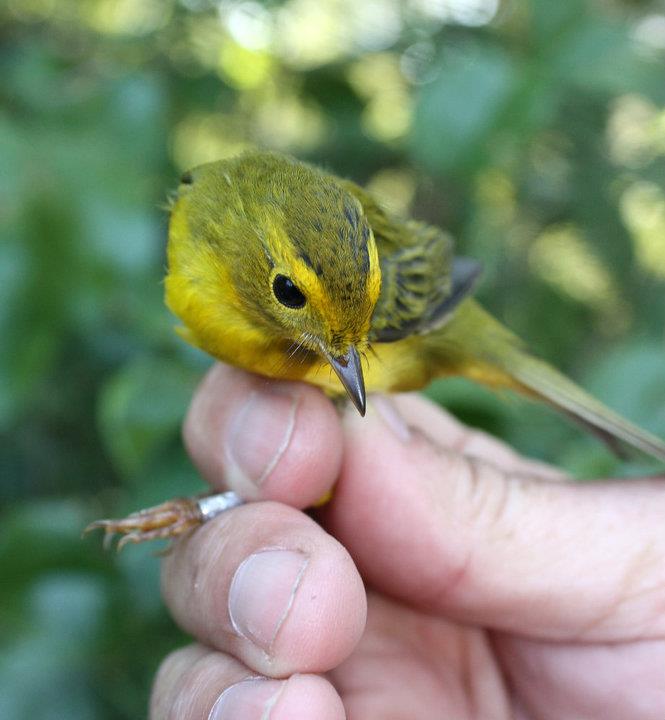
This past week the Kohl Gallery opened an exquisite exhibit entitled "In Pursuit of Beauty: John J. Audubon and the Golden Age of Bird Illustration." This exhibit features works from Audubon, but also includes prints from William Beebe, Charles Lucien Bonaparte, Daniel Giraud Elliot, John Gould, and Alexander Wilson. The exhibit is scheduled to run until Friday, November 30th and is open Wednesday through Sunday 1-6 pm.
Philosophers have searched for an answer to the question "What is Beauty?" over countless years and from many different perspectives. The veins of a feather, the curve of a wing in flight, or the brush strokes that build a picture? This exhibit explores the question of beauty through the lens of the natural world. Audubon and his colleagues searched to capture the mystery, dignity, and innocence of the creatures that filled their world and often times their bellies. There is a focus in this exhibit on game birds and the practice of sport shooting in the United States. The added dimension of relationship between the subject and the painter creates a more intimate environment. It is almost as if Audubon is glorifying his relationship with the birds he hunts by immortalizing them on the canvas.
The addition of a video by Brian Palmer deepens the reality of the exhibit. The video opens with the stillness of the pre-dawn and follows a day at Foreman's Branch Banding Station. The audience is taken through the bird banding process and given face to face exposure to some of the birds that have inspired these great painters. “To see birds being released, taking wing—it’s the most wonderful thing,” Alex Castro, Curator of the Kohl Gallery, comments. “And at the center of it all, these beautiful still images of birds from the past.”Layering the still photographs with the video of the live birds blurs the line between the paintings and the creatures to create an oasis of wilderness right in the heart of Campus.
The careful and thoughtful planning of Alex Castro and Assistant Curator, Sean Meade, brought this breathtaking vision to fruition. On Tuesday, October 9th dozens of people gathered to celebrate their work at the Exhibit Opening. President Reiss and Dean DiQuinzio, advisor for the Kohl Gallery were present to offer their congratulations and comment on the astounding beauty of this exhibit.
To visit the Kohl Gallery click here.
To visit the Foreman's Branch Bird Observatory click here.
Showing posts with label birds. Show all posts
Friday, October 12, 2012
Wednesday, September 19, 2012
Working Landscapes
This past Saturday, fellow CES staffer Dan Small and I
attended a grassland and shrubland bird symposium sponsored by Virginia Working
Landscapes and held at the Smithsonian Conservation Biology Institute in Front
Royal, Virginia. VWL is a consortium of
groups interested in, among other things, establishing demonstration sites to
showcase best practices for various land uses on working farms and creating a
network for landowners to exchange information and ideas.
![]() |
| Bobolink in fall plumage. |
We knew it was going to be a good day when the first item on
the agenda was a bird walk and tour of a nearby farm. The group of 25 or so landowners and managers
admired and discussed the grass buffers, their species composition and what
problems or challenges they had faced in their own efforts to create and
maintain grasslands. As we ambled through
Big Bluestem and Indian Grass we heard the constant calls of Bobolinks moving
between the grass stand and the adjacent alfalfa field. Other
grassland birds detected included Grasshopper Sparrows and a Dickcissel. It was almost as though Dan had planted the
birds as a primer for his talk about the CRFRS grasslands (he highlighted all
three species).
![]() |
| Male Dickcissel. Photo by Bill Hubick |
Back at the lecture hall, speakers covered such topics as bird-friendly
haying practices on Vermont dairy farms, maximizing bird habitat on public
lands and identifying suitable habitat for Golden-winged Warblers. Dan Small, representing CRFRS and CES, described
the establishment and management of the warm season grasslands on Chino Farms/
Chester River Field Research Station and the birds that have colonized the
site.
Mike Wilson, of William and Mary’s Center for Conservation Biology,
spoke about determining the appropriate use of land based on the size of the
area. Many grassland birds require larger
spaces for breeding habitat than other species.
This means that you could install a perfect looking five acre grassland,
but those five acres are probably not enough to sustain any grassland
birds. If you only have five acres of
property, he suggests managing it as a shrubland instead. Many species of birds requiring second-growth
scrub/shrub habitats are in decline.
Birds such as Golden-winged Warblers, Yellow-breasted Chats, Dickcissels
and Northern Bobwhites are facing great challenges due to habitat loss and
could greatly benefit from managing lands for them.
| Shrub/scrub habitat may look messy to humans, but looks safe and inviting to birds and other wildlife. |
We met many enthusiastic landowners who wanted to provide
the great bird habitat that was also compatible with other land uses such as
haying, farming and hunting. It was
exciting to see so many like-minded folks and to hear about some of the
compromises available to landowners.
Several expressed interest in seeing CRFRS firsthand and learning more
about what we have accomplished on Chino.
Maren Gimpel is a field ecologist at the Chester River Field Research Station. Photos and stories about the goings on of CRFRS can be found at www.facebook.com/crfrc or at www.washcoll.edu/ces/chesterriverfieldresearchcenter
Wednesday, September 5, 2012
Northern Bobwhite
Many landowners on Maryland’s Eastern Shore lament the loss
of Northern Bobwhite (quail) on their property. The fact that quail have been
disappearing from their former habitats is nothing new, concerned citizens and
wildlife biologists have been worried about this game bird’s future in Maryland
for some time now. But all is not lost; with a little dedication and help from
private landowners the negative population trend can be reversed. The Center
for Environment & Society has teamed up with Tall Timbers Research Station
to form The Northern Bobwhite Quail Restoration Initiative. One of the goals of
the project is to form a regional network of private landowners who are interested
in restoring the habitat necessary for Bobwhite to make a comeback.
![]() |
| Adult Male Northern Bobwhite. Photo by Bill Hubick. |
Habitat loss is often cited as the leading cause of
population declines for quail. In Maryland they have declined at a rate of 5.1%
per year since 1966 and at an accelerated 7.3% per year since 1980 (Ellison
2010). Restoring quail will involve increasing habitat surrounding farm fields,
including grasslands or overgrown fields, shrub-scrub, woodland edges and
hedgerows between farm fields. Chino Farms in northern Queen Anne’s County is
leading efforts in the area to provide the mix of ideal habitats that quail
need. Creating and maintaining early successional habitat is a work in progress,
but with persistent dedication, time and the guidance from Tall Timbers the
farm is becoming a model and resource for other interested landowners.
| A small part of the restored warm season grasslands on Chino Farm. |
With the rapid advancements
in modern farming technologies, the way we practice farming has changed a lot in
just a short period of time. In the past quail could rely on fence rows,
hedgerows and fallow fields, but with larger equipment came larger fields and
these critical habitats were lost. Back then landowners and managers didn’t
have to manage their properties specifically for quail, the farming practices
simply were good for quail. Today’s quail live in a completely different
environment. Nowadays, land managers
have to actively manage the land to support quail. Another goal of the Intiative
is to bring together landowners to share experiences on what works and what
doesn’t, everyone has ideas and input and sharing them with the group will
benefit everyone involved.
If you are interested in
creating quail habitat or know someone who may be interested, please keep an
eye out here or at the CES facebook page for more information about a quail
forum this fall. The unmistakeable whistle call of the male Northern Bobwhite
belongs in the rural landscape and with your help we can all work together to
make sure they are around for generations to come.
Information can also be found here, http://www.washcoll.edu/ces/chesterriverfieldresearchcenter/quailrestoration.php.
Thanks to Bill Hubick for allowing use of his photographs. www.billhubick.com
Dan Small is a field ecologist at the Chester River Field Research Station. Please visit our Facebook page www.facebook.com/crfrc or find additional information here www.washcoll.edu/ces/chesterriverfieldresearchcenter
Friday, August 24, 2012
A Week of Warblers!
This past week at the banding station was filled with exciting warblers! Here are some pictures of the best and the brightest. Also check out our weekly banding totals for a more detailed look at what we've been catching at Foreman's Branch Bird Observatory.
This past week we got a high number of American Redstarts of all ages and sexes gathered in one area of the study site. Perhaps they are traveling in a group?
We banded 5 Black and White Warblers this week.
We also got an HY (hatch year) Female Wilson's Warbler this week. You can see that the top of her head is much greener than a male's would be.
This HY Male Blackburnian Warbler was a real treat. We usually only get one a year, and some years we don't get any.
Ok, so this is not a warbler but we broke the record for number of Belted Kingfishers captured this year, and that's pretty neat too!
All signs point to...Migration! Hopefully we'll continue to get interesting and exciting birds in the coming weeks. Be sure to check out day-by-day updates on our facebook page and our weekly banding totals on our Website.
This past week we got a high number of American Redstarts of all ages and sexes gathered in one area of the study site. Perhaps they are traveling in a group?
We banded 5 Black and White Warblers this week.
We also got an HY (hatch year) Female Wilson's Warbler this week. You can see that the top of her head is much greener than a male's would be.
This HY Male Blackburnian Warbler was a real treat. We usually only get one a year, and some years we don't get any.
Ok, so this is not a warbler but we broke the record for number of Belted Kingfishers captured this year, and that's pretty neat too!
All signs point to...Migration! Hopefully we'll continue to get interesting and exciting birds in the coming weeks. Be sure to check out day-by-day updates on our facebook page and our weekly banding totals on our Website.
Sunday, August 5, 2012
Bobolink...What's that?
![]() |
| Male Bobolink. Photo by Bill Hubick. |
Well, it’s a bird and a fascinating one at that. The Bobolink,
Dolichonyx oryzivorus, is a songbird in
the blackbird family (Icteridae). As you can see from the pictures to the right and below, males
and female are sexually dimorphic in the spring and summer months when the male
has unmistakable black and white plumage with a straw colored nape. The female
retains cryptic coloration year-round which is made up of straw colored body
plumage with black streaking on the flanks.
Bobolinks are long distant migrants traveling thousands of miles
annually from their breeding grounds in North America to their wintering
grounds in South America, roughly 6000 miles one way!!! Males not only have
unique plumage, but have a very unique song, follow this link to hear what they
sound like, http://www.xeno-canto.org/sounds/uploaded/CDTGHVBGZP/BOBO2007-6-3-2.mp3,
recorded by Andrew Spencer. Some people
think they sound like R2-D2 from Star Wars.
![]() |
| Female Bobolink. Photo by Bill Hubick. |
Bobolinks require grasslands or something very similar, like
alfalfa or hay fields, in which to nest. They can be found in Maryland during
migration in both spring and fall and they breed in western and northern counties
in the state. Maryland is at the very southern end of the breeding range for
Bobolinks. They don’t breed on the eastern shore, but some attempt to nest in
the northern reaches of Cecil County in hay fields.
Bobolinks have experienced range-wide population declines
due to a variety of reasons, with habitat loss considered the single biggest
factor. Most native grasslands and wet meadows have disappeared and they have
been forced to nest in crop and hay fields as a result. In terms of habitat quality, hay fields are
not bad, but the problem is harvesting the hay while birds are still nesting.
Farmers need to cut the hay at its nutritional peak which is often prior to young
birds fledging or when they are still too young to fly. Biologists, especially
in Vermont, are working with farmers to delay the cutting to allow nests to
fledge.
| Adult male Bobolink in breeding plumage. |
Many Bobolinks use the CRFRS restored grassland on Chino
Farm as stopover and refueling site during spring migration. But, the best time
to see them in the grasslands is July through September. Adult males arrive
first, still in their distinctive breeding plumage, followed by adult females
and then in August and September by the young of the year. The restored
grasslands provide critical habitat for the Bobolinks that stop here in the
fall. Not only do the grasslands provide a bounty of food, in the form of
insects and unlimited grass seed, but the tall thick fields act as a refuge.
Bobolinks are somewhat unique among east coast birds in that they do not molt
on their breeding grounds or the wintering grounds, but rather somewhere in
between. This is where the restored grasslands are important.
![]() | ||||||||
| Adult male Bobolink undergoing flight feather molt. |
Molt is the process of feather replacement that all birds
under take annually. Soon after the adult Bobolinks arrive in the grasslands
they begin the pre-basic molt which is complete, meaning they will molt, or
replace, all their feathers. Only after this molt is complete in about 3-4 weeks
will these birds continue their south-bound migration. All Bobolinks will again
undergo a complete molt prior to leaving their wintering grounds for their spring
migration back north. Flocks of over 300 individuals have been seen in the
fields. What we don’t know yet is whether the same individuals use the
grasslands as a molting ground every year or whether we always see different
individuals. There are only two bird species in North America that go through
two complete molts each year, Bobolinks are one of them, do you know what the
other species is?
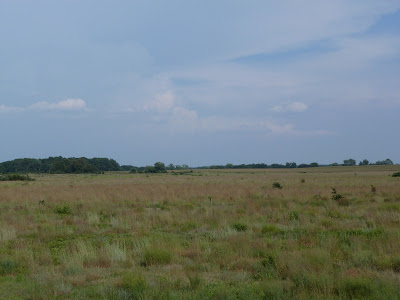
| Sweeping views of the CRFRS restored grasslands on Chino Farm. |
The CRFRS restored grasslands are not only providing
critical breeding habitat for declining species such as Grasshopper Sparrow,
Field Sparrow, Dickcissel and Northern Bobwhite and are a great winter habitat for
a diversity of grassland dependent species but are also playing a fundamental
role in the life cycle of Bobolinks.
Thanks to Bill Hubick for the use of his photographs. More of his photos can be seen at www.billhubick.com
Dan Small is a field ecologist at the Chester River Field Research Station and spends just about everyday in the summer months in the restored grasslands. For more information go to www.facebook.com/crfrc or www.washcoll.edu/ces/chesterriverfieldresearchcenter
Friday, July 27, 2012
Close Looks at Birds
I mentioned a few weeks ago a great project going on behind the scenes at CES: we've slowly been cataloging all the pictures ever taken at Chino Farm and trying to get as many of them online as possible.
Well, we've made it through the first stages, and now many of the amazing pictures taken of birds during banding at Foreman's Branch Bird Observatory (FBBO) are available online here. The species are organized by family to the extent possible, though of course some categories have multiple families, and some birds are just hard to categorize. But we've done our best! It was exciting to go through all the pictures that have been taken, and realize first hand the history of the research done at FBBO.
While all of the pictures are impressive, I of course have some favorites, especially the owl and raptor pages. The raptor page is a good example of what we hope to accomplish with these albums. In addition to having a photo of each species, we'd like to show differences between males and females, adults and juveniles, and other variation you might see within the species. At some point we'll also include pictures of the things banders look for when collecting information about these birds. In addition, over time, more information about each species, including information about when certain individuals were caught, data that has been collected on those species, and possibly even sounds will be added to the pages. But all of that, of course, takes time! Not to mention that some of the pictures are, gasp!, on film! All of those will have to await an intern who can scan them in.
Finally, you can also access the albums from our tables of banding data. Now, if you are curious about a species that has been recently banded, you can click on the species name and view photos of that bird.
So as a special bonus for blog readers, here are some photos that didn't make it onto the site (yet!):
There are so many great pictures yet to share- hope you check out the albums! You can also see the latest in bird glamor shots by following CRFRS on facebook.
Tara Holste is the Web Content Manager for the Center for Environment & Society, as well as a recent convert to the world of birding.
Well, we've made it through the first stages, and now many of the amazing pictures taken of birds during banding at Foreman's Branch Bird Observatory (FBBO) are available online here. The species are organized by family to the extent possible, though of course some categories have multiple families, and some birds are just hard to categorize. But we've done our best! It was exciting to go through all the pictures that have been taken, and realize first hand the history of the research done at FBBO.
While all of the pictures are impressive, I of course have some favorites, especially the owl and raptor pages. The raptor page is a good example of what we hope to accomplish with these albums. In addition to having a photo of each species, we'd like to show differences between males and females, adults and juveniles, and other variation you might see within the species. At some point we'll also include pictures of the things banders look for when collecting information about these birds. In addition, over time, more information about each species, including information about when certain individuals were caught, data that has been collected on those species, and possibly even sounds will be added to the pages. But all of that, of course, takes time! Not to mention that some of the pictures are, gasp!, on film! All of those will have to await an intern who can scan them in.
Finally, you can also access the albums from our tables of banding data. Now, if you are curious about a species that has been recently banded, you can click on the species name and view photos of that bird.
So as a special bonus for blog readers, here are some photos that didn't make it onto the site (yet!):
| Check out these Kingfisher feet! |
| Most people have never seen this bird- the Common Nighthawk |
![]() |
| Here's its relative, the Whip-poor-will |
| I just can't get enough of this bird, the Pileated Woodpecker |
| Whoa! |
![]() |
| Here's some little screech owls |
| And a little fluffy one |
![]() |
| Sharp-shinned hawk |
![]() |
| And finally, a young Northern Bobwhite |
Tara Holste is the Web Content Manager for the Center for Environment & Society, as well as a recent convert to the world of birding.
Thursday, July 26, 2012
Chino Farm: A Week in Pictures
This week at the banding station Amanda Spears caught one of the first migrants of the season: a Black and White Warbler!
Bobolinks are officially here to stay. Well...at least to molt. The grasslands are getting filled up with Bobolinks as they feast on foxtail grass and begin their molt before continuing south on migration.
This past week banding on the grasslands jumped in numbers. Among the birds being captured were Orchard Orioles, like this one.
The nesting continues! Grasshopper Sparrows are trying to get one more clutch in before they have to start worrying about migration.
We've been happy to see plenty of young Northern Bobwhite around the grasslands this summer. It seems like they've had a productive breeding season. To check out the latest from the grasslands take a look at our Facebook page.
Next week marks the start of fall banding at FBBO, don't forget to check out our website for the latest updates from the banding station!
Bobolinks are officially here to stay. Well...at least to molt. The grasslands are getting filled up with Bobolinks as they feast on foxtail grass and begin their molt before continuing south on migration.
This past week banding on the grasslands jumped in numbers. Among the birds being captured were Orchard Orioles, like this one.
The nesting continues! Grasshopper Sparrows are trying to get one more clutch in before they have to start worrying about migration.
We've been happy to see plenty of young Northern Bobwhite around the grasslands this summer. It seems like they've had a productive breeding season. To check out the latest from the grasslands take a look at our Facebook page.
Next week marks the start of fall banding at FBBO, don't forget to check out our website for the latest updates from the banding station!
Wednesday, July 25, 2012
What's inside that birdhouse?
| Eastern Bluebird nest. The chick is only a few hours old. |
One of the many fun things I get to do as a Field
Ecologist with CES is checking the nestboxes on Chino Farms/CRFRS. There are about 100 boxes spread out over
several miles of roads and trails. More
or less once a week from mid-March through August someone checks each box and
records what is inside. Usually, that
someone is me. Most of the time it’s an adventure to make the circuit- I
run into Bluestem Farms staff, I watch an Osprey catch a fish, I hear the wheezy
call notes of Blue-gray Gnatcatchers,
I admire the flowers in bloom. Did I mention this is my job?
| Carolina Chickadess back in the nest after having been banded. |
I keep a record of what is in each box all season. I band the chicks when they are old enough and when they have fledged the nest, I remove it so the box is ready for it's next residents. Each box is a surprise- I never know what will be
inside! A box that was empty last week
could have a full nest this week. A nest
that last week had chicks could be all torn up with no birds to be found. Most of the boxes are used by Tree Swallows
and Eastern Bluebirds. Less frequent
residents include Carolina Chickadees, Tufted Titmice, House Wrens and
Great-crested Flycatchers. Sometimes the birds banded as chicks stay on the property to breed as adults. There are several old titmice and bluebirds still around that hatched in one of our boxes.
Of course, a sturdy, water tight cavity is prime real estate to many animals and not all visitors are birds. Several boxes host Flying Squirrels which we allow to stay. Mice are frequent squatters and we try to discourage them. Sometimes, a birdhouse with eggs inside is a boxed lunch for a raccoon or opossum or a snake. Everything needs to eat.
| Young Black Rat Snake inside what had been a bluebird nest. |
![]() |
| Mice like our birdhouses quite a bit. |
The Tree Swallows have finished nesting for the season, but there are still 3 boxes with House Wren nests and 7 with bluebird nests. Bluebirds can nest quite late into the summer. The latest we’ve had a bluebird fledge on Chino was September 6th! Looks like I have weeks of nest checks still ahead of me. I don’t mind.
Maren Gimpel is a field ecologist at the Chester River Field Research Station. Photos and stories about the goings on of CRFRS can be found at www.facebook.com/crfrc or at www.washcoll.edu/ces/chesterriverfieldresearchcenter
Monday, July 23, 2012
Summer Fun at Bombay Hook
This past week the crew at CRFRS took a trip to Bombay Hook in Delaware as a reward for all of their hard work this summer. As we got our things together to start the trip I remembered how exciting it is to go out with a big group and learn together. For many in the crew this was a brand new experience. All the scopes were loaded into the car, binoculars were cleaned up and placed around necks, and Sibley (bird guide) was featured prominently on the dash. Then off we went! On the way into the reserve we were already hearing and seeing plenty of birds, so we knew that it was going to be a good day.
We arrived at the first pond and set up our scopes. “Rachel can you count the Dowitchers? I’ve got the Semi’s,” Banding intern Amanda Spears said to me as we scanned the pond. Every August Bombay Hook fills up with thousands of shorebirds that are experiencing migration. Many of these birds are among the farthest travelers of any animal. Some of them will have flown up to Alaska to breed and are on their way to South America to winter, and for that one day we were able to witness a part of their journey. “I’ve got a Western (Western Sandpiper) over here,” field ecologist Dan Small said as he looked through his spotting scope. As the interns were learning (and I was beginning to remember) one of the great joys of shore birding is looking through huge groups of birds to try and pick out that one that might be different. Unless you know what you’re looking for Semipalmated and Western Sandpipers look practically identical. We were interested in looking through the flocks to test our identification skills and learn new tricks. As I continued counting Short-Billed Dowitchers, I could hear Dan giving birding tips to the interns and showing them examples of what he looks for when identifying shorebirds.
“Anybody counted those Snowy Egrets yet?” Maren Gimpel, field ecologist, asked. We were taking time to note each species and count each individual so that we could submit the data to an online database called “eBird.” eBird provides birders an opportunity to keep their own records while simultaneously contributing to a record of bird sightings for the entire country. After our trip, Amanda carefully entered all of the birds we saw and submitted them to the eBird database. These data are then reviewed by the people at eBird and uploaded to the web. By putting the information on the web other birders can also access the information and see where/what time of year other birders have had exciting finds.
By the time we left we’d seen a good variety of birds and some pretty exciting ones too! The interns got a fun introduction to birding and we’re so grateful for all their hard work this summer.
To take a look at some of the birds we saw at Bombay Hook take a look at our eBird checklist
| Shorebirds covered the mudflats at Bombay Hook |
| The interns were learning some new birding techniques! |
| Maren Gimpel consults a bird book |
Thursday, July 12, 2012
Summer Scenery at Chino Farm
Even in the heat, it's a lot of fun being outside all day surrounded by animals and plants. Here are some highlights from the Chester River Field Research Station this past week!
Don't forget to check out the latest from CRFRS and FBBO on the website and facebook pages!
| Blue Grosbeak Nest |
| Breeding Ovenbirds at FBBO |
| Interns and Guests around the banding truck |
| Field Ecologist Dan Small extracts a bird during banding |
| The long-awaited return of the Bobolinks has finally arrived! |
Monday, July 2, 2012
Take a kid birding
I’ve
borrowed this slogan from the Cape May Bird Observatory because it’s a great
idea- adults who already love birding and getting outside can expose the next
generation to the natural world by bringing along some kids on their next
outing. Or adults who know nothing about
the outdoors can still venture out with some youth in tow. In Maryland, the youth division of the
Maryland Ornithological Society (YMOS) has been promoting this idea for years. Under the leadership of Dr. Wayne Bell (former
director of CES) and Mr. George Radcliffe, YMOS combines education, field trips
and fun for interested teens throughout the state. Each summer, YMOS joins with CES to run a
unique week-long residential camp based at Washington College.
The
program is special in that the participants are both students and
educators. This year the program ran
from June 25-29 and was composed of 2 adults and 8 students who spent the week
both in the field and in the classroom.
Participants learned basic bird ID skills, the value of contributing
their sightings to the eBird database and took field trips to local birding hot
spots like Bombay Hook NWR in Delaware and Elk Neck State Park in Cecil County.
| Dan Small, CRFRS field ecologist extracts a bird from a mist net. |
On Friday,
the last day of their program, they spent the morning with field ecologists
Maren Gimpel and Dan Small in the Chester River Field Research Station’s
restored grasslands. They were excited
to learn about the important scientific contributions of bird banding as well
as to see birds up close. They were also
thrilled to see some birds they hadn’t seen yet during their week like
Dickcissel and Northern Bobwhite.
Dozens
of participants have now completed the workshop and other YMOS
programming. Among that group of alums
is Amanda Spears, now a sophomore at the University of Vermont. Since finding invaluable mentors through the
Maryland birding community and YMOS in particular, Amanda has gone on to be one
of the best young birders in the state and has decided to pursue a degree in
wildlife biology. She has been a
volunteer at Foreman’s Branch Bird Observatory (even getting class credit for
her effort while at Queen Anne’s County High School), an intern in the
CRFRS grasslands and is now an intern in charge of summer banding at FBBO. About YMOS Amanda says "While my passion
for birds and wild things blossomed in my backyard, close mentors such as
George Radcliffe and Wayne Bell allowed me to jump the fence and explore
migrations and natural wonders happening tens, hundreds, and even thousands of
miles away from home. Without their support and shared experience, my knowledge
base would be limited and I may not have pursued my deep interests in ecology and
conservation. I thank all my mentors for helping me realize when I am happiest:
in discovery with those I love."
| Dan Small shows the YMOS group an American Robin. |
Clearly,
the exposure and support Amanda got from adults around her played an important
role in her development as a young adult.
A mentor need not be a natural history expert to fill such a role for a child
or teen. Something as simple as taking a
walk and working together to identify a wildflower can be a learning experience
for both of you. Who knows when or
where you can inspire someone else to appreciate the world around them.
Information
on the 2013 YMOS workshop and other activities for young birders and educators
can be found at www.ymos.org. Photos and stories about the goings on of
CRFRS can be found at www.facebook.com/crfrc
or at www.washcoll.edu/ces/chesterriverfieldresearchcenter
Maren Gimpel is a field ecologist
at the Chester River Field Research Station.
Friday, June 29, 2012
Lights, Camera, Action!
Sharing Chino Farms is always an exciting experience. Whether it's with a birding group, school group, or family there's something engaging about describing all of the wonderful research happening at Chino/CRFRS/FBBO and seeing other people become interested. For the interns at CRFRS, Wednesday was especially exciting because not only were they asked to share their work, they were filmed too! Shane Brill from Washington College's Office of College Relations and his crew of interns came out to the grasslands at Chino Farms to see what it was all about.
Students were able to talk about their research and the film crew even got to see some birds up close when they interviewed Dan Small (field ecologist) and Eric Waceiga (summer intern) who were banding birds. Many of the students talked about the Grasslands as a great opportunity for conservation. Shane and the crew were also very interested in discussing the implications of our research for the agricultural community. Jeff Sullivan (summer intern) discussed the impact traditional farming methods have on diversity and the potential for increasing that diversity with smart management techniques like buffer strips. Ian Hall (summer intern) described some of his work in the crop fields and noted that not only the diversity but the volume of birds decreased as a result of commercial agriculture.
What ecologists are learning is that everything is impossibly intertwined. We cannot simply bring Grasshopper Sparrows back to Maryland and dump them into a corn field, they would not thrive. We need to start with the grasses that will encourage the insects, which will eventually entice the birds. This also means that when we destroy something like a meadow or a stand of trees, we are impacting much more than we know. Through observation, documentation, experimentation, and publication of our research at CRFRS/FBBO we are learning who we are as human beings and where we fit in the larger ecosystem that is the world.
To learn more about CRFRS and FBBO check us out on facebook! www.facebook.com/CRFRC
Or take a look at our site on the CES webpage:
www.washcoll.edu/ces/chesterriverfieldresearchcenter
| Intern Eric Waceiga talks with the film crew. |
| Film intern Harris Allgeier releases a Red-Winged Blackbird. |
To learn more about CRFRS and FBBO check us out on facebook! www.facebook.com/CRFRC
Or take a look at our site on the CES webpage:
www.washcoll.edu/ces/chesterriverfieldresearchcenter
Subscribe to:
Posts (Atom)


+wing+molt+07-23-07.jpg)