Showing posts with label Chester River Field Research Center. Show all posts

Friday, August 24, 2012

A Week of Warblers!

This past week at the banding station was filled with exciting warblers! Here are some pictures of the best and the brightest. Also check out our weekly banding totals for a more detailed look at what we've been catching at Foreman's Branch Bird Observatory.
This past week we got a high number of American Redstarts of all ages and sexes gathered in one area of the study site. Perhaps they are traveling in a group?
We banded 5 Black and White Warblers this week.
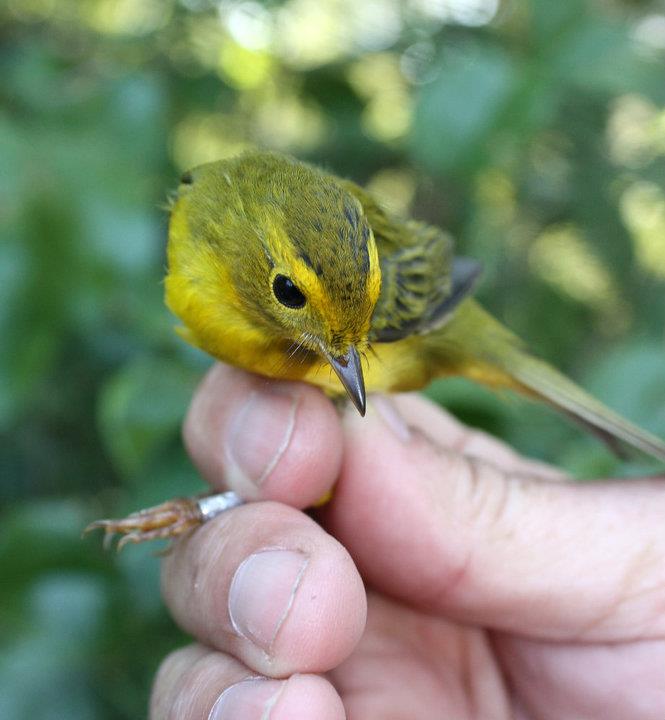
We also got an HY (hatch year) Female Wilson's Warbler this week. You can see that the top of her head is much greener than a male's would be.
This HY Male Blackburnian Warbler was a real treat. We usually only get one a year, and some years we don't get any.
Ok, so this is not a warbler but we broke the record for number of Belted Kingfishers captured this year, and that's pretty neat too!
All signs point to...Migration! Hopefully we'll continue to get interesting and exciting birds in the coming weeks. Be sure to check out day-by-day updates on our facebook page and our weekly banding totals on our Website.

Thursday, August 16, 2012

Turtle Power!

Chino Farm is not just for the birds! A small group of Washington College students, led by Dr. Aaron Krochmal, have been studying the turtles on the property for the past few years. I had the opportunity to talk to Brendyn Meisinger ‘13, a student intern, about his research.

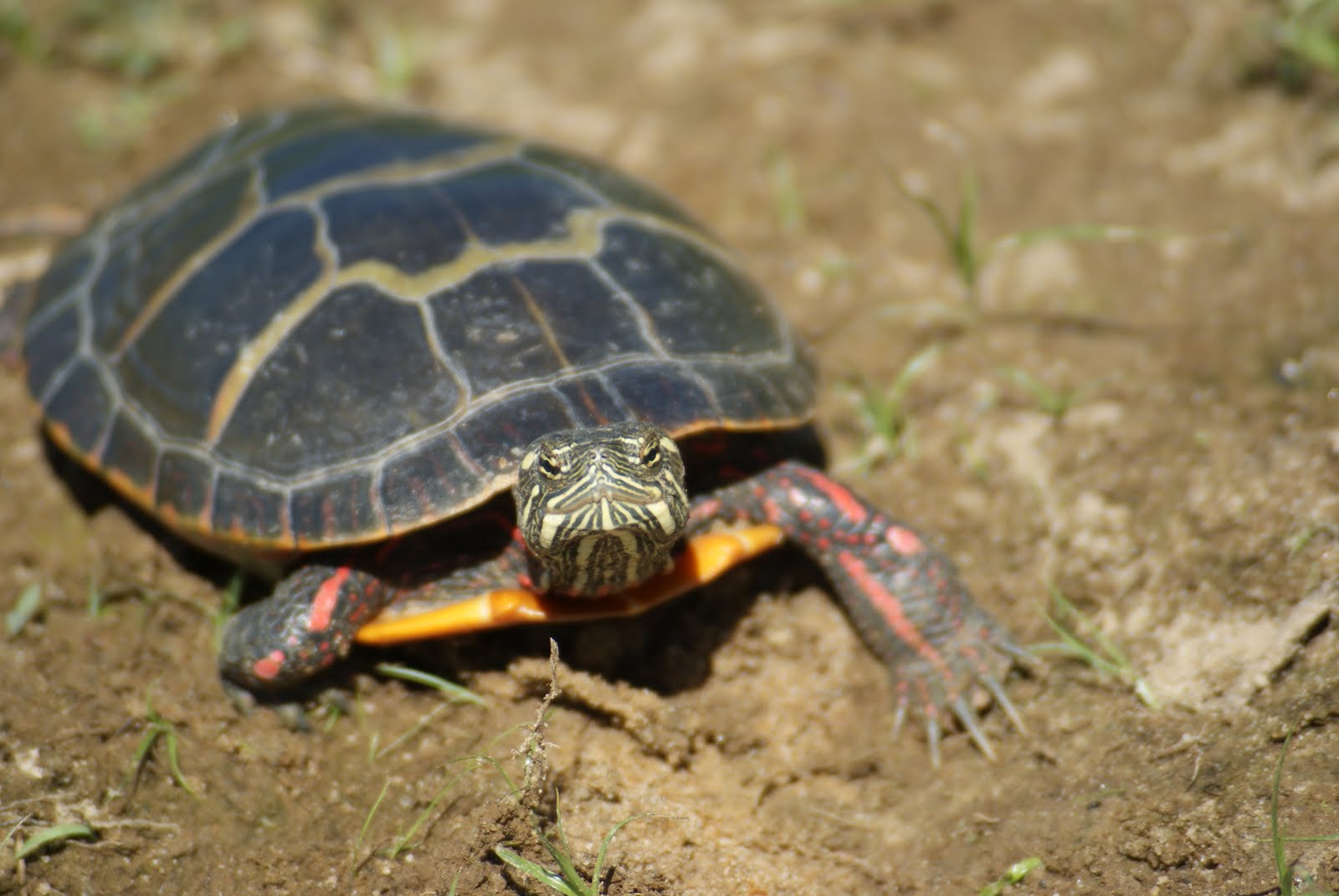
Painted Turtle at Chino Farm
This summer Brendyn put 5 radio transmitters on Eastern Red Painted Turtles so that he could monitor their movements. Brendyn was inspired by some of Dr. Krochmal’s previous research, which examined the potential methods turtles use to find new ponds once the ones they are using have dried up. Brendyn wanted to know how the turtles at Chino Farm find new Delmarva Bays to use during the summer.
What is a Delmarva Bay? You might ask. Well, Delmarva Bays are vernal pools that are something of a mystery to scientists. We do know that they provide essential habitat for a wide variety of reptiles and amphibians. The soil and plant life found in Delmarva Bays are unique. Chino Farm proudly boasts a large number of Delmarva Bays. So much so in fact, that Brendyn was able to pick his own to study and name it whatever he chose. Consequently, Brendyn is studying at “Morrison’s Retreat”, a Delmarva Bay he named after Robert Morrison who founded Phi Delta Theta fraternity.

What do the turtles do once the Delmarva Bays have dried up?
Eventually Brendyn would like to use some of this research for his Senior Capstone Experience, and there’s plenty to go around! This project has many possible directions and students, along with Dr. Krochmal, will hopefully be able to present their findings this coming April at North East Fisheries and Wildlife conference.

Dr. K looks for turtles at Chino Farm
Rachel Field is the Education Coordinator at CES.

Wednesday, August 1, 2012

Other than water, what does the rain bring?


No alarm needed this morning.   Thunder was crackling and rain falling well before the 6 a.m. clang of the set clock.  Rainfall on the eastern shore evokes different feelings for different people.  Farmers, for example, are happy that their parched corn might survive to adulthood. My mind then moves to the ramification of the rain in the Chester River Watershed, where the drops hit and and, ultimately,  what it collects as it flows down hill off the fields and into the Bay. It’s a light rain so it’s unlikely that there will be runoff.  Where will the water end up and what will it bring with it?

Yesterday I was over at Foremans Branch on Chino Farms in Chestertown talking with Ted Kimble and Henry Davis about siting a most sophisticated water quality sampling station.  Ted’s going to work with Choptank Electric to drop the electric service in, that will power the station.  Henry will work his magic clearing the long grass and shrubs so the system can be installed and serviced without a threat of contracting poison ivy.  We’re talking with Dr. Jim Gruber to make sure that this project doesn’t interfere with his bird banding research.  We also had to know how high the water gets during slamming rainfall that happens during Nor’easters and hurricanes. So much to do before we take our first sample.

The fancy gizmo will pump water quietly from Foremans Branch to the sensors and then gravity will whisk it back to whence it came. The sensors will let us know what is coming off of the fields and through the grounds from the farm, woods, and grasslands into the water.  During dry times we’ll know that the contributions we’re measuring are leaking into the water through the ground.  When it rains we originally would have expected to see spikes in stuff coming into the water because of runoff.  Our friend Judy Denver up at USGS says that’s probably not the case. We’ll likely see water quality improve during these “freshets”. That’s because the additional water dilutes the nutrients and other “additives” from the farms and roads.  Even though the water quality improves, the volume of water flowing through the system is so high that, overall, the amount of extraneous materials entering the system is still elevated. Look at it this way.  If you have a gallon of water with a pound of sugar in it, it tastes like sugar water.  If you have five gallons of water with two pounds of sugar in it, there is more sugar, but it doesn’t taste as sweet.  So rain and runoff probably worsens water quality.  Doug, did you say “Probably?”.  Yes, I did. 

Once we install this Hach Water Quality measuring station we’ll investigate the truth of this assertion.  Water temperature, salinity, conductivity, pH (acidity), dissolved oxygen, turbidity (how dirty the water is), nutrient content, and water level data will be sent to our website every fifteen minutes.  Coupled with a weather station on the farm we’ll be able to see the relationship between rainfall and water quality.  Communicating with the farm we’ll be able to see how farming practices, including fertilizer application, relates to changes in the chemistry of the water flowing through Foremans Branch down to the Chester River.  We’re hoping to have this information on line for everyone to see.  This will change that "Probably" to an answer with more certainty. I’ll let you know when we throw the switch.  Get in touch if you have questions. Doug Levin is the  Associate Director, Center for Environment & Society @ Washington College and can be reached at dlevin2@washcoll.edu.


This is the site where we originally thought the water quality installation was going.


This photo taken at flood stage convinced us to place the system up the hill from the bridge.


Friday, July 27, 2012

Close Looks at Birds

I mentioned a few weeks ago a great project going on behind the scenes at CES: we've slowly been cataloging all the pictures ever taken at Chino Farm and trying to get as many of them online as possible.

Well, we've made it through the first stages, and now many of the amazing pictures taken of birds during banding at Foreman's Branch Bird Observatory (FBBO) are available online here.  The species are organized by family to the extent possible, though of course some categories have multiple families, and some birds are just hard to categorize.  But we've done our best!  It was exciting to go through all the pictures that have been taken, and realize first hand the history of the research done at FBBO.

While all of the pictures are impressive, I of course have some favorites, especially the owl and raptor pages.  The raptor page is a good example of what we hope to accomplish with these albums.  In addition to having a photo of each species, we'd like to show differences between males and females, adults and juveniles, and other variation you might see within the species.  At some point we'll also include pictures of the things banders look for when collecting information about these birds.  In addition, over time, more information about each species, including information about when certain individuals were caught, data that has been collected on those species, and possibly even sounds will be added to the pages.  But all of that, of course, takes time!  Not to mention that some of the pictures are, gasp!, on film!  All of those will have to await an intern who can scan them in.

Finally, you can also access the albums from our tables of banding data.  Now, if you are curious about a species that has been recently banded, you can click on the species name and view photos of that bird.

So as a special bonus for blog readers, here are some photos that didn't make it onto the site (yet!):

Check out these Kingfisher feet!

Most people have never seen this bird- the Common Nighthawk
Here's its relative, the Whip-poor-will
I just can't get enough of this bird, the Pileated Woodpecker
Whoa!
Here's some little screech owls
And a little fluffy one
Sharp-shinned hawk
And finally, a young Northern Bobwhite
There are so many great pictures yet to share- hope you check out the albums!  You can also see the latest in bird glamor shots by following CRFRS on facebook.


Tara Holste is the Web Content Manager for the Center for Environment & Society, as well as a recent convert to the world of birding.

Thursday, July 26, 2012

Chino Farm: A Week in Pictures

This week at the banding station Amanda Spears caught one of the first migrants of the season: a Black and White Warbler!
Bobolinks are officially here to stay. Well...at least to molt. The grasslands are getting filled up with Bobolinks as they feast on foxtail grass and begin their molt before continuing south on migration.
This past week banding on the grasslands jumped in numbers. Among the birds being captured were Orchard Orioles, like this one.
The nesting continues! Grasshopper Sparrows are trying to get one more clutch in before they have to start worrying about migration.
We've been happy to see plenty of young Northern Bobwhite around the grasslands this summer. It seems like they've had a productive breeding season. To check out the latest from the grasslands take a look at our Facebook page.
Next week marks the start of fall banding at FBBO, don't forget to check out our website for the latest updates from the banding station!

Wednesday, July 25, 2012

What's inside that birdhouse?

Eastern Bluebird nest.  The chick is only a few hours old.

One of the many fun things I get to do as a Field Ecologist with CES is checking the nestboxes on Chino Farms/CRFRS.  There are about 100 boxes spread out over several miles of roads and trails.  More or less once a week from mid-March through August someone checks each box and records what is inside.  Usually, that someone is me.  Most of the time it’s an adventure to make the circuit-  I run into Bluestem Farms staff, I watch an Osprey catch a fish, I hear the wheezy call notes of Blue-gray Gnatcatchers, I admire the flowers in bloom. Did I mention this is my job? 
Carolina Chickadess back in the nest after having been banded.

I keep a record of what is in each box all season. I band the chicks when they are old enough and when they have fledged the nest, I remove it so the box is ready for it's next residents.  Each box is a surprise- I never know what will be inside!  A box that was empty last week could have a full nest this week.  A nest that last week had chicks could be all torn up with no birds to be found.  Most of the boxes are used by Tree Swallows and Eastern Bluebirds.  Less frequent residents include Carolina Chickadees, Tufted Titmice, House Wrens and Great-crested Flycatchers.  Sometimes the birds banded as chicks stay on the property to breed as adults.  There are several old titmice and bluebirds still around that hatched in one of our boxes.

Of course, a sturdy, water tight cavity is prime real estate to many animals and not all visitors are birds.  Several boxes host Flying Squirrels which we allow to stay.  Mice are frequent squatters and we try to discourage them.  Sometimes, a birdhouse with eggs inside is a boxed lunch for a raccoon or opossum or a snake.  Everything needs to eat.
Young Black Rat Snake inside what had been a bluebird nest.
Mice like our birdhouses quite a bit.

The Tree Swallows have finished nesting for the season, but there are still 3 boxes with House Wren nests and 7 with bluebird nests.  Bluebirds can nest quite late into the summer.  The latest we’ve had a bluebird fledge on Chino was September 6th!  Looks like I have weeks of nest checks still ahead of me.  I don’t mind.

Maren Gimpel is a field ecologist at the Chester River Field Research Station.  Photos and stories about the goings on of CRFRS can be found at www.facebook.com/crfrc or at www.washcoll.edu/ces/chesterriverfieldresearchcenter

Monday, July 23, 2012

Summer Fun at Bombay Hook

This past week the crew at CRFRS took a trip to Bombay Hook in Delaware as a reward for all of their hard work this summer. As we got our things together to start the trip I remembered how exciting it is to go out with a big group and learn together. For many in the crew this was a brand new experience. All the scopes were loaded into the car, binoculars were cleaned up and placed around necks, and Sibley (bird guide) was featured prominently on the dash. Then off we went! On the way into the reserve we were already hearing and seeing plenty of birds, so we knew that it was going to be a good day.
Shorebirds covered the mudflats at Bombay Hook
We arrived at the first pond and set up our scopes. “Rachel can you count the Dowitchers? I’ve got the Semi’s,” Banding intern Amanda Spears said to me as we scanned the pond. Every August Bombay Hook fills up with thousands of shorebirds that are experiencing migration. Many of these birds are among the farthest travelers of any animal. Some of them will have flown up to Alaska to breed and are on their way to South America to winter, and for that one day we were able to witness a part of their journey. “I’ve got a Western (Western Sandpiper) over here,” field ecologist Dan Small said as he looked through his spotting scope. As the interns were learning (and I was beginning to remember) one of the great joys of shore birding is looking through huge groups of birds to try and pick out that one that might be different. Unless you know what you’re looking for Semipalmated and Western Sandpipers look practically identical. We were interested in looking through the flocks to test our identification skills and learn new tricks. As I continued counting Short-Billed Dowitchers, I could hear Dan giving birding tips to the interns and showing them examples of what he looks for when identifying shorebirds.
The interns were learning some new birding techniques!
“Anybody counted those Snowy Egrets yet?” Maren Gimpel, field ecologist, asked. We were taking time to note each species and count each individual so that we could submit the data to an online database called “eBird.”  eBird provides birders an opportunity to keep their own records while simultaneously contributing to a record of bird sightings for the entire country. After our trip, Amanda carefully entered all of the birds we saw and submitted them to the eBird database. These data are then reviewed by the people at eBird and uploaded to the web. By putting the information on the web other birders can also access the information and see where/what time of year other birders have had exciting finds. By the time we left we’d seen a good variety of birds and some pretty exciting ones too! The interns got a fun introduction to birding and we’re so grateful for all their hard work this summer.
Maren Gimpel consults a bird book
To take a look at some of the birds we saw at Bombay Hook take a look at our eBird checklist

Friday, July 13, 2012

From My Perch

As I drove down High Street to the Custom House this morning, I looked straight ahead to the river.  It was calm.  Flat.  The air was cool, the skies were overcast, and that pretty, cyan green ketch that visits Chestertown every summer from New England was poised on the water as though waiting for its close-up, Mr. DeMille.  Close to the High Street dock was a raft of mallards soaking up the warmth of the pavement.

A day at the Custom House always begins with a view of the river.  Lucky I am.  I try to wrangle all of CES from my desk in the house ... all seven who work in the Custom House and the many others who make vital contributions to our good work from farther afield.  You've heard from most of the others.  I'm here to make their jobs easier.

All in a day's work.


Jenifer is the Coordinator and Office Manager for the Center for Environment & Society and can be contacted here.

Thursday, July 12, 2012

Summer Scenery at Chino Farm

Even in the heat, it's a lot of fun being outside all day surrounded by animals and plants. Here are some highlights from the Chester River Field Research Station this past week!
Blue Grosbeak Nest

Breeding Ovenbirds at FBBO

Interns and Guests around the  banding truck
Field Ecologist Dan Small extracts a bird during banding
The long-awaited return of the Bobolinks has finally arrived! 
Don't forget to check out the latest from CRFRS and FBBO on the website and facebook pages!

Monday, July 9, 2012

Monardas of Maryland


Each time I walk by some Monarda in the restored grasslands at Chino Farms I’m reminded how beautiful nature can be.  Others working in the fields this summer have also commented on the beauty of these plants and asked if I knew what they were. Inspired by these questions, here is an overview of the species of Monarda found in Maryland.


Bee Balm, Monarda didyma. Has brilliant crimson flowers with oval, narrowly pointed and toothed leaves. Found in moist woods, thickets and bottomlands.

Monarda is a genus made up of 16 species, five of which occur in Maryland and all of which are endemic to North America. Monardas belong in the family Lamiaceae (the mint family) and share several characteristics common in the mint family such as having square stems and leaves that are fragrant when crushed.
Four out of the five species occurring in Maryland can be found on Chino Farms. Dotted Monarda and Wild Bergamot are found growing in the restored grasslands while Bee Balm and Purple Bergamot were planted in the native plant garden at Foreman’s Branch Bird Observatory. 


Purple Bergamot, Monarda media. Purple Flowers with leaves that are oval or broadly triangular. Found in moist woods and thickets.
Wild Bergamot, Monarda fitulosa. Pink flowers with narrowly triangular or oval leaves that are pointed and toothed. Upland woods, thickets and prairies.

Several Native American tribes used plants in the genus Monarda for medicinal purposes. They were used as antiseptics, made into a tea to treat mouth and throat infections and also used to stop headaches.  Monards were also used to season game meat. 


Dotted Monarda, Monarda punctata. Whitish to pink flowers with narrow oval or oblong leaves. Found in dry fields and roadsides.

Bee Balm, White Bergamot and Purple Bergamot are found in the mountainous regions of Maryland, while Wild Bergamot and Dotted Monarda are widespread and can be found throughout the state. White Bergamot is ranked as a S1 plant (highly state rare) by the Maryland Natural Heritage Program, and Purple Bergamot is ranked as a SU meaning possibly rare but status uncertain. 


White Bergamot, Monarda clinopodia.  White flowers with narrow triangular or oval leaves that are rounded at the base. Found in moist woods, thickets, ravines and banks. Photo by Homer Price.


 Thanks to Homer Edward Price for his use of his photo, http://www.flickr.com/photos/28340342@N08/2981721109/. Information for this post was gathered from Wikipedia, the MD Natural Heritage Programs, Rare, Threatened and Endangered Plants of MD report, http://dnr.maryland.gov/wildlife/Plants_Wildlife/rte/pdfs/rte_Plant_List.pdf. An excellent wildflower guide, Wildflowers in the Field and Forest by Steven Clemants and Carol Gracie was also very useful.

Dan Small is a field ecologist at the Chester River Field Research Station

Monday, July 2, 2012

Summer Research at Chino Farms


Check out our summer interns at Chino Farms!

Take a kid birding

I’ve borrowed this slogan from the Cape May Bird Observatory because it’s a great idea- adults who already love birding and getting outside can expose the next generation to the natural world by bringing along some kids on their next outing.  Or adults who know nothing about the outdoors can still venture out with some youth in tow.  In Maryland, the youth division of the Maryland Ornithological Society (YMOS) has been promoting this idea for years.  Under the leadership of Dr. Wayne Bell (former director of CES) and Mr. George Radcliffe, YMOS combines education, field trips and fun for interested teens throughout the state.  Each summer, YMOS joins with CES to run a unique week-long residential camp based at Washington College.  
The program is special in that the participants are both students and educators.  This year the program ran from June 25-29 and was composed of 2 adults and 8 students who spent the week both in the field and in the classroom.  Participants learned basic bird ID skills, the value of contributing their sightings to the eBird database and took field trips to local birding hot spots like Bombay Hook NWR in Delaware and Elk Neck State Park in Cecil County.
Dan Small, CRFRS field ecologist extracts a bird from a mist net.
On Friday, the last day of their program, they spent the morning with field ecologists Maren Gimpel and Dan Small in the Chester River Field Research Station’s restored grasslands.  They were excited to learn about the important scientific contributions of bird banding as well as to see birds up close.  They were also thrilled to see some birds they hadn’t seen yet during their week like Dickcissel and Northern Bobwhite.
Dozens of participants have now completed the workshop and other YMOS programming.  Among that group of alums is Amanda Spears, now a sophomore at the University of Vermont.  Since finding invaluable mentors through the Maryland birding community and YMOS in particular, Amanda has gone on to be one of the best young birders in the state and has decided to pursue a degree in wildlife biology.  She has been a volunteer at Foreman’s Branch Bird Observatory (even getting class credit for her effort while at Queen Anne’s County High School), an intern in the CRFRS grasslands and is now an intern in charge of summer banding at FBBO.  About YMOS Amanda says "While my passion for birds and wild things blossomed in my backyard, close mentors such as George Radcliffe and Wayne Bell allowed me to jump the fence and explore migrations and natural wonders happening tens, hundreds, and even thousands of miles away from home. Without their support and shared experience, my knowledge base would be limited and I may not have pursued my deep interests in ecology and conservation. I thank all my mentors for helping me realize when I am happiest: in discovery with those I love."
Dan Small shows the YMOS group an American Robin.

Clearly, the exposure and support Amanda got from adults around her played an important role in her development as a young adult.  A mentor need not be a natural history expert to fill such a role for a child or teen.  Something as simple as taking a walk and working together to identify a wildflower can be a learning experience for both of you.   Who knows when or where you can inspire someone else to appreciate the world around them.
Information on the 2013 YMOS workshop and other activities for young birders and educators can be found at www.ymos.org.  Photos and stories about the goings on of CRFRS can be found at www.facebook.com/crfrc or at www.washcoll.edu/ces/chesterriverfieldresearchcenter
Maren Gimpel is a field ecologist at the Chester River Field Research Station.

Friday, June 29, 2012

Lights, Camera, Action!

Sharing Chino Farms is always an exciting experience. Whether it's with a birding group, school group, or family there's something engaging about describing all of the wonderful research happening at Chino/CRFRS/FBBO and seeing other people become interested. For the interns at CRFRS, Wednesday was especially exciting because not only were they asked to share their work, they were filmed too! Shane Brill from Washington College's Office of College Relations and his crew of interns came out to the grasslands at Chino Farms to see what it was all about.
Intern Eric Waceiga talks with the film crew. 
Students were able to talk about their research and the film crew even got to see some birds up close when they interviewed Dan Small (field ecologist) and Eric Waceiga (summer intern) who were banding birds. Many of the students talked about the Grasslands as a great opportunity for conservation. Shane and the crew were also very interested in discussing the implications of our research for the agricultural community. Jeff Sullivan (summer intern) discussed the impact traditional farming methods have on diversity and the potential for increasing that diversity with smart management techniques like buffer strips. Ian Hall (summer intern) described some of his work in the crop fields and noted that not only the diversity but the volume of birds decreased as a result of commercial agriculture.
Film intern Harris Allgeier releases a Red-Winged Blackbird.
What ecologists are learning is that everything is impossibly intertwined. We cannot simply bring Grasshopper Sparrows back to Maryland and dump them into a corn field, they would not thrive. We need to start with the grasses that will encourage the insects, which will eventually entice the birds. This also means that when we destroy something like a meadow or a stand of trees, we are impacting much more than we know. Through observation, documentation, experimentation, and publication of our research at CRFRS/FBBO we are learning who we are as human beings and where we fit in the larger ecosystem that is the world.
To learn more about CRFRS and FBBO check us out on facebook! www.facebook.com/CRFRC
Or take a look at our site on the CES webpage:
www.washcoll.edu/ces/chesterriverfieldresearchcenter

Monday, June 25, 2012

Chester River Association Annual Meeting


Last Thursday, June 21st, the Chester River Association hosted their 2012 Annual Meeting, open to the public.  It was a lovely evening of 100 or so friends, members, board members and colleagues in Washington College’s Casey Academic Center.   I was very pleased to attend both as a colleague from CES and a CRA board member excited to announce our annual Riverkeeper Award recipient.   The evening started off with a warm welcome from Board President, Marcy Ramsey, who immediately recognized the efforts of CRA’s staff.  A special nod went to the work of our newest member and Executive Director, Heather Forsythe.   

CRA’s conservation planner, Paul Spies was next on the line up with a warm welcome and wit for the evening’s keynote speaker, Dr. Josh McGrath, a soil fertility specialist with UMD extension.  As some of you may know, CRA has been promoting a cutting edge precision Ag technology called “Greenseeker.”   Dr. McGrath is a resident expert in Greenseeker technology and is compiling data for CRA’s Greenseeker pilot project.   Essentially, the technology reads exactly how much nitrogen is needed for each corn plant in a farmer’s field as the farmer is applying fertilizer.   Greenseeker communicates to a variable rate fertilizer applicator which does it’s best to apply only what is needed.  There is a little disconnect between the two technologies at this point, but CRA’s pilot project may help to make application more precise.   Dr. McGrath’s point:  if farmers can optimize their fertilizer use from the start—down to the plant!—then we won’t have to spend as much money retroactively remediating our nutrient load issues from the agricultural sector i.e. riparian buffers, cover crops, grass swales, etc.  It’s a win/win/win:  farmer’s spend less, produce more food, and reduce nutrient runoff.   Keeping farms profitable and well managed is a goal for CRA, because it will help keep our water clean.  Precision agriculture is a science-based way to get there. 

For that reason, you won’t be surprised to learn that this year’s Riverkeeper Award went to our very own Chino Farms and Blue Stem Farming Operation!  Dr. Harry Sears, Evan Miles, and their team of dedicated staff have done a fantastic job exemplifying stewardship through precision farming and progressive land conservation.  As the Chester Riverkeeper, David Foster, pointed out, it might be why Foreman’s Branch—the largest creek on Chino—showed a noteworthy resurgence in this past year’s river report card while other creeks declined.   But make no mistake, Chino Farms has been employing cutting edge stewardship, research, and agriculture for many years.  CES is fortunate to have become a part of that commitment and is proud and excited that Chino and Blue Stem have received such a prestigious award!

Mike Hardesty is Assistant Director of the Chesapeake Semester at CES.

To learn more about the Chester River Association visit:

To learn more about Chino Farm’s and CRFRC visit their website at http://www.washcoll.edu/ces/chesterriverfieldresearchcenter/.

Thursday, June 21, 2012

Bring on the Heat!


The temperatures are rising, but the summer fun continues at Chino! Over at the banding station Amanda Spears, summer CES intern, is capturing a steady amount of birds and managing to avoid the heat so far. During the rain day last week she was able to start some statistical analysis of the banding data, putting her college statistics course to good use! Over in the grasslands at CRFRS the interns are forging ahead with territory mapping and nest searching. On Wednesday June 13th the interns found a whopping total of 3 Dickcissel nests. This past week marked the beginning of bi-weekly surveys of the grasslands conducted by Maren Gimpel, field ecologist, and Rachel Field, CES intern. These data will help develop an understanding of the variety and volume of birds using the grasslands during the breeding season.
Dickcissel decoy for target banding
Dan Small, field ecologist, banded last week along with Jeff Sullivan, summer CES intern, (in between the rainy and windy days) and they were catching a good number of Orchard Orioles. They also put color bands on plenty of Grasshopper and Field Sparrows! Dan is once again engaged in a battle of wits against the male Dickcissels, who are proving to be the most challenging grassland bird to target band. Target banding involves setting up one or two nets in the hopes of catching a specific bird to be color banded. Maybe the latest decoy will tempt some of the males to fly into the nets?
Rachel with one of the Osprey chicks
Over the weekend intrepid volunteers gathered at Chino for the annual Osprey banding effort. Under the direction of long-time volunteer Bill Snyder and bander Jim Gruber, the team went around the farm to the various Osprey platforms and banded the young from the nests. Osprey banding has been carried out on the farm since 1998 and we have banded over 80 individuals. Some of our Osprey have been recovered very far from home. In 2002 one of our Osprey was found shot in Trinidad, and in 2008 another was found in Ecuador. Check out pictures from Osprey banding on CRFRS's Facebook page.
To learn more  about the work at CRFRS in the Grasslands read last week's blog entry: Summer at Chino Farms
Rachel Field is an intern with CES working with various aspects of the research and administration for Chino Farms/CRFRS.

Wednesday, June 20, 2012

Dream Come True

Lately I’ve been fortunate to have what I think of as a dream project- I’ve been going through all the pictures of birds taken at Foreman’s Branch Bird Observatory in an effort to put at least one picture of every bird up on the website. This may not sound like a dream project to most people- I mean, it’s just endlessly going through pictures of birds and resizing them, right? And with around 190 species banded at the station over the years, it’s quite a lot of pictures.
No, the reason it’s a dream job is because I’ve become a birder. Three years ago I met my partner, incidentally a former CRFRC employee and bander, and he of course had to get me hooked. At first I was reluctant- I mean, birding, right? People make fun of that hobby. But I’ve always enjoyed being outdoors and for me birding meant a deeper understanding of what I was seeing as I hiked around- it literally opened my eyes to things I never even knew were there. Now my own personal life list is hovering around 175, and it’s time to start really firming up my knowledge of birds. By sorting through these pictures and posting them, I get to not only test my knowledge (is that a Canada warbler or a Cape May warbler?), I also get to see the other birds I need to keep a look out for when I’m out and about. My identification skills have improved by leaps and bounds just in the last few weeks.
We’re not just putting these pictures online for the fun of it (though it is fun). Eventually these pictures will become an educational tool- in addition to pictures of each species, there will be pictures of males and females of the same species, close ups showing key features banders use to age each bird, and information about the individuals that were banded at the station. Did you know there’s a Northern Shrike (not at all common on the Eastern Shore of Maryland!) who has returned to Chino Farm for the past six years?

All of this information will be presented along with lesson plans for teachers and guides for using the albums as a resource- for expert banders and researchers from around the world, to bird enthusiasts, to the general public, who, like me, didn’t know a thing about the wide variety of birds that visit us every year!
The albums are still under development, but I’ll give you a sneak peek, just to whet your appetite. Stay tuned for further developments, and be sure to check out up to the minute photos of birds being banded at the Chester River Field Research Center facebook page.
Warblers Banded at Foreman’s Branch Bird Observatory
Tara Holste is an amateur birder and the web manager for the Center for Environment & Society at Washington College.