Showing posts with label Interns. Show all posts

Friday, July 12, 2013

Pilgrim on Radcliffe Creek

Arial view of Radcliffe Creek
Despite the time that I have spent in Chestertown as a student of Washington College, it was not until about two months ago that I first heard of Radcliffe Creek. Even as an Environmental Studies major, this creek was something that I had not been introduced to in my two years in school. As I began to research the history of the creek and its watershed, I met with some members from the town who are currently planning the construction of three retention pools at the source of Radcliffe Creek. Radcliffe Creek begins to form very near to the LaMotte building and the Acme shopping center on Route 213. The mouth of the creek is roughly a quarter mile from the Boat House on South Cross Street and feeds directly into the Chester River. Radcliffe Creek was identified as an area of impaired water in the Middle Chester River Restoration Action Strategy (MD DNR 2002) and the purpose of these retention pools is to help improve the water and habitat quality of Radcliffe so that it may no longer be considered impaired. During my research it was discovered that there used to be an old dumpsite in an area just south of Cromwell Clark Road. Additionally, there was a coal/gas manufacturing plant located on 813 West High Street—an area that backs up directly to Radcliffe Creek—that operated from 1910 to 1946. After these discoveries, the idea of performing sediment sampling and trace metal testing in addition to nutrient and water quality testing became much more prevalent. The creek itself is primarily fed by ground water and storm water runoff and has very low salinity (the average salinity of the creek is a mere 0.2 ppt). The plant life within the creek consists mostly of phragmites but there are healthy strands of cattails amongst the phragmites in addition to some forest vegetation along some of the banks of the creek.
Osprey with dinner

The times that I have kayaked along the creek I have seen numerous Ospreys, Red-winged Black Birds, Great Blue Herons, two muskrats, a few turtles (I was not able to get close enough to determine the type of turtle), and some very small fish. The creek itself has high potential to become a fantastic area for wildlife, as it is already home to many different types of organisms. Since there had been no prior delineation of it, one of the first things that I began doing when I found out about Radcliffe Creek was delineate its watershed in order to get an idea of the land that contributes to its runoff. I also went out on the creek and measured various depths of Radcliffe so that a 3D bathymetric model of the creek can be produced at some point. Since there has been virtually no research conducted on Radcliffe Creek, there is a lot to catch up on and even more to pursue. My primary focus for the past two months has been to test the overall water quality of Radcliffe. I perform biweekly surveys of the creek and measure temperature, salinity, dissolved oxygen (both in mg/L and % saturation), Chlorophyll a and pH using a water quality sonde. I also take water samples from four different sites along the creek and use them to test for ammonia, nitrate, orthophosphate, total nitrogen and total phosphorus. The average amount of total nitrogen within the creek has been 2.5 mg/L and the average total phosphorus is 0.26 mg/L which produces a nitrogen (N) to phosphorus (P) ratio of about 10 to 1 rather than the16 to 1 that is typically needed for phytoplankton. (This means that for every atom of P used a phytoplankton cell needs 16 atoms of N – on average). It appears that N may be limiting phytoplankton growth, at least for the short period of time that I have been investigating the Radcliffe Creek water quality.
Students paddling on Radcliff Creek
My hope is that this research and data collection will be able to continue over the years so that a better understanding of the ecosystem quality of Radcliffe Creek emerges. Radcliffe has huge potential to become an even more wonderful and habitable creek than it is currently and my hope is that by raising awareness and learning more about the charming creek, Radcliffe will become one of the gems of Chestertown. I would like to thank all of the people who have helped me with this research—my fellow students Sarah Winters, Olivia Hughes and Rachel Stoddard and professors Christian Krahforst, Leslie Sherman and Karl Kehm. I would not have been able to do this without their fantastic efforts.

Drew Hobbs is an Environmental Studies major with minors in Computer Science and Chemistry. He will be starting his Junior year at Washington College in the fall.

Thursday, August 16, 2012

Turtle Power!

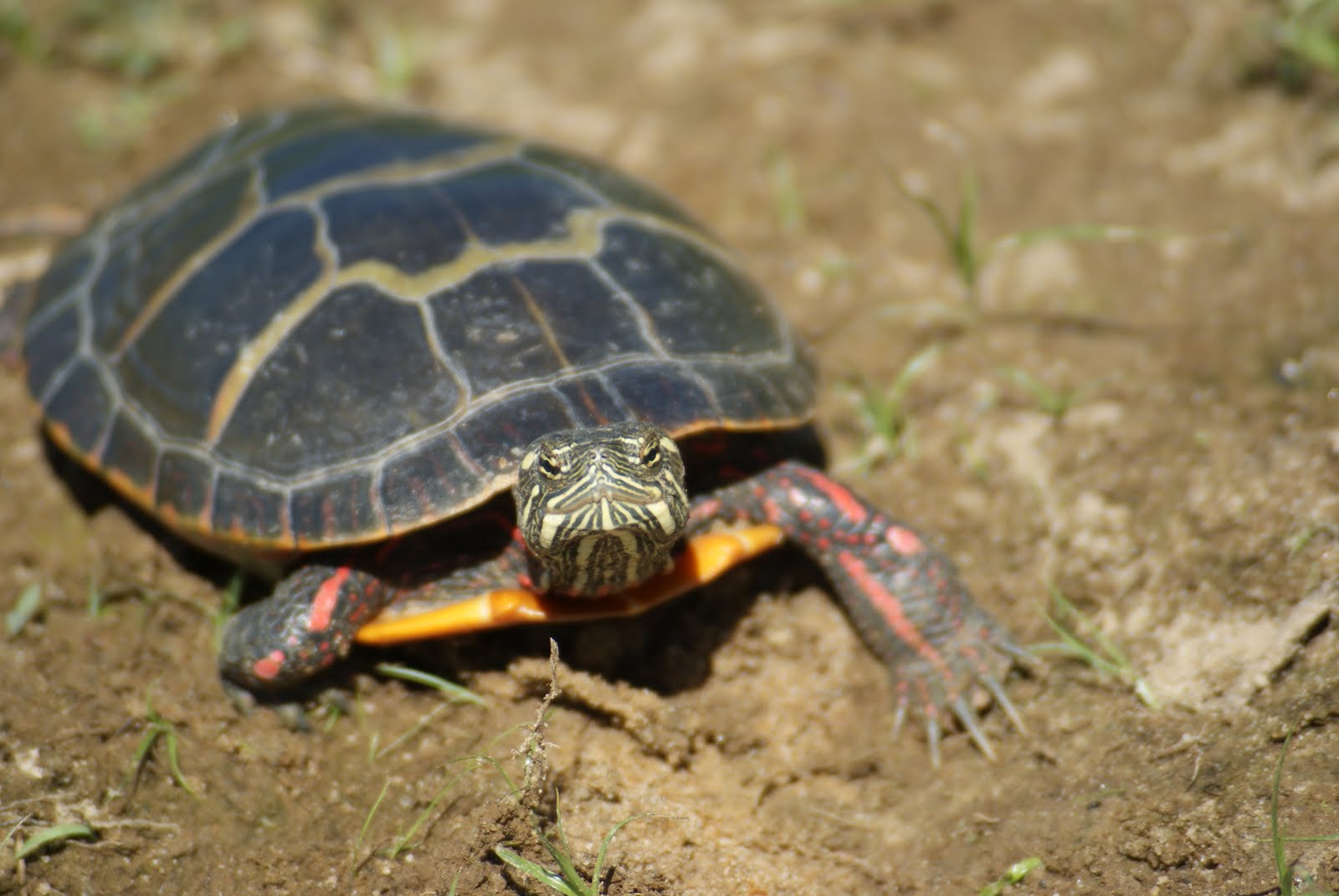
Chino Farm is not just for the birds! A small group of Washington College students, led by Dr. Aaron Krochmal, have been studying the turtles on the property for the past few years. I had the opportunity to talk to Brendyn Meisinger ‘13, a student intern, about his research.

Painted Turtle at Chino Farm
This summer Brendyn put 5 radio transmitters on Eastern Red Painted Turtles so that he could monitor their movements. Brendyn was inspired by some of Dr. Krochmal’s previous research, which examined the potential methods turtles use to find new ponds once the ones they are using have dried up. Brendyn wanted to know how the turtles at Chino Farm find new Delmarva Bays to use during the summer.
What is a Delmarva Bay? You might ask. Well, Delmarva Bays are vernal pools that are something of a mystery to scientists. We do know that they provide essential habitat for a wide variety of reptiles and amphibians. The soil and plant life found in Delmarva Bays are unique. Chino Farm proudly boasts a large number of Delmarva Bays. So much so in fact, that Brendyn was able to pick his own to study and name it whatever he chose. Consequently, Brendyn is studying at “Morrison’s Retreat”, a Delmarva Bay he named after Robert Morrison who founded Phi Delta Theta fraternity.

What do the turtles do once the Delmarva Bays have dried up?
Eventually Brendyn would like to use some of this research for his Senior Capstone Experience, and there’s plenty to go around! This project has many possible directions and students, along with Dr. Krochmal, will hopefully be able to present their findings this coming April at North East Fisheries and Wildlife conference.

Dr. K looks for turtles at Chino Farm
Rachel Field is the Education Coordinator at CES.

Tuesday, August 14, 2012

Searching for Rangia

Our summer began with periodic excursions up and down the mighty Chester River looking for “soft” sediment that we hope to use for characterizing the chemistry of the bottom of Chester River. Why, you might ask? Well, many of the “chemicals of environmental concern”(COEC) are hydrophobic -which literally means afraid of water- but more appropriately reflects the sticky-particle bound nature of many of these contaminants. They don’t like to be dissolved in water, but like to bind to the surfaces of particles and, ultimately, the sediment. Our interest in COECs is directed towards a better understanding of how these chemicals are introduced into the aquatic environment, how they affect resident organisms, and where they may ultimately end up. Anyway, this communiqué is not about COECs but is more about the benthos – the critters that we found in or on the sediment during our summer of mucking about in boats. Overall, we found very little living in the sediments we collected - or more appropriately, very little macro (large, non-microscopic) organisms. For those macro benthic organisms we did find we noted where, when, and what we found; either an occasional oyster, some mussels, and most often – when there was anything – the mighty Rangia.
 This is blog is about the brackish clam,Rangia cuneata (Fig.1); what their role may be in the Chester River ecosystem and whether they might be a good indicator of contaminant exposure and bio-accumulation (accumulation of chemicals in the tissues of the organism) in the Chester.
Fig. 1. Rangia collected from the Chester River about 2 miles south of Chestertown
The Rangia clam, according to information provided by the Maryland Department of the Environment (MDE)1, is a brackish (low salinity) clam that is often found in waters with salinities between 5-15 parts per thousand (fresh water is 0 ppt, ocean water at the mouth of the Chesapeake is ~32 ppt). They often live in highly turbid waters (water that contains a lot of suspended particles, muddy), often preferring soft substrates; usually a sand/mud mixture with vegetation detritus. They are subtidal suspensivores (they filter material out of the water column for food) and are also considered saprophytic, that is they also derive nourishment from dead or decaying organic matter (much like bacteria or fungi). The species found in the Chesapeake are Rangia cuneata and, to this date, the Chesapeake is the northern most reach of their distribution. Apparently, they weren’t always a part of the Chesapeake ecosystem. In fact (according to MDE), the first known sighting of R. cuneata was in 1960 in the Potomac River and are now found in the brackish tributaries and creeks of the upper Chesapeake Bay. Does the timing of their occurrence correspond to increases turbidity in the Chesapeake? Definitely an interesting question…. As a food source for humans, they are considered non-desirable, often because they have an earthy, muddy taste. Investigators from NOAA2 report a very active fishery for Rangia along the east coast of Mexico where they are used as a supplement to local shellfish and fish cuisine, often because they present a less desirable pallet when served alone. In Figure 2, we show where we have found Rangia this summer. The sites where we collected sediment are indicated by black triangles and where we found Rangia clams are shown by the red circles. One hope is that these organisms can help filter and clean the highly turbid waters of the Chester or the even the lower salinity realms of the Bay . Some investigators3 show that Rangia is a good indicator of a system under significant stress; that they represent a situation where other organisms struggle to survive and the ecosystem is in poor health. Rangia are also being investigated as a potential contaminant cleaner-upper for the impact of the BP oil release in the Gulf of Mexico4 Figure 2. Surface sediment grabs sites (black triangles) from the Chester River, summer 2012. The red dots overlay stations where we found Rangia clams.
Fig. 2.
Surface sediment grabs sites (black triangles) from the Chester River, summer 2012. The red dots overlay stations where we found Rangia clams
One of our interests at the Center for the Environment and Society is whether Rangia can serve as biological indicator for contaminant exposure in the Chester River ecosystem. Do contaminants like lead, copper, arsenic and other COEC accumulate in Chester River resident organisms? Is Rangia a potential pathway for the transfer COEC to “higher” organisms that reside in the Chester River ecosystem (e.g., white perch, osprey, humans,etc) where COEC may become further concentrated as they move up the food chain? We don’t know, but we will be measuring the content of some of the COEC in their soft tissues using the relatively new high tech inductively-coupled Mass Spectrometer at Washington College. Stay tuned!


Samuel Hartman, a summer Hodson Fellow, looks to find the optimal site for our next sediment grab
 Christian Krahforst is the Mellon Post Doctoral Fellow of Biogeochemistry for the Center for Environment & Society at Washington College.

1.  http://www.mde.state.md.us/programs/Marylander/CitizensInfoCenterHome/Documents/www.mde.state.md.us/assets/document/Rangia.pdf
2.  http://spo.nmfs.noaa.gov/mfr663/mfr6632.pdf
4.  http://www.nola.com/news/gulf-oil-spill/index.ssf/2011/03/lowly_rangia_clam_as_oil-sucki.html